
Most garage door jobs split cleanly in two. Safe for a careful homeowner: cleaning and aligning the photo-eye sensors, lubricating rollers and hinges, replacing remote batteries, and clearing grit from the tracks. Never attempt on your own: springs, lift cables, bottom brackets, and any track work under tension. When in doubt, the safe answer is the technician.
Most garage door jobs split cleanly in two. This honest guide draws the safety line, task by task, so you know what to fix yourself and what to leave to a trained technician.
A garage door that will not close, a remote that suddenly does nothing, a spring that snapped with a bang loud enough to hear from the kitchen. Most homeowners meet their garage door properly for the first time on a bad morning, phone in one hand and a video tutorial playing. The video makes the fix look like a Saturday job. The door itself tells a different story. This guide draws the honest line between the jobs a careful homeowner can safely do and the jobs that belong to a trained technician, with the Colorado Springs conditions that move that line.
What makes a garage door repair dangerous in the first place?
It is not the size of the door that makes garage door work dangerous. It is the energy stored inside it. A closed garage door is held up by springs — torsion springs wound tight above the opening, or extension springs stretched along the side tracks. Those springs carry almost the entire weight of the door, and they hold that energy whether the door is open or closed. A winding bar that slips, a cable that lets go, or a bracket bolt loosened at the wrong moment releases that energy in a fraction of a second.
The danger is invisible. A door that looks perfectly still can hold hundreds of pounds of stored force above your head, and nothing about its appearance tells you how much tension is in the springs or how worn a cable is inside its drum. Homeowners get hurt not because garage doors are complicated, but because the risk hides behind a door that worked fine yesterday.
The opener makes the misjudgement worse, because it is not the muscle of the system. It is the guide. The springs do the lifting; the opener moves a balanced door along its tracks. Treat the opener as the lifter and everything else follows: the release cord pulled on a door whose springs have already failed, or the force settings turned up so the opener keeps forcing a binding door until something breaks.
Add height and leverage, and the margin shrinks further: garage door work happens on ladders, reaching overhead, with both hands busy and the door above you. The line between safe and unsafe is drawn by physics, not by confidence. A job is safe when nothing in it can release stored energy, drop the door, or put you under a moving part.
Which garage door jobs are genuinely safe to do yourself?
The safe jobs share one quality: they change nothing about the forces holding the door up. Start with the photo-eye sensors at the base of the tracks — the small lenses that tell the opener whether the path is clear, and the most common reason a door refuses to close. Wipe each lens with a soft, dry cloth, check that nothing blocks the beam, and make sure the brackets have not been knocked loose. Work from the floor, with the door closed.
Lubrication is the second safe job. With the door closed, apply a garage-door-rated lubricant to the rollers, the hinges, and the opener rail, then wipe away the excess. A standard household grease stiffens in cold weather and turns into a paste that makes the door drag — the opposite of what you want in a Colorado Springs January. Never lubricate the tracks themselves.
Replacing remote or keypad batteries is safe, and so is replacing a torn or brittle bottom seal, which slides into a retainer and carries no tension. Clearing grit and leaves from the tracks is safe too, with the door closed. On the Front Range, hail season drives grit into the tracks from mid-April to mid-September, and a track full of grit makes a door grind and bind exactly like a spring problem. Clear the tracks before you decide anything is broken.
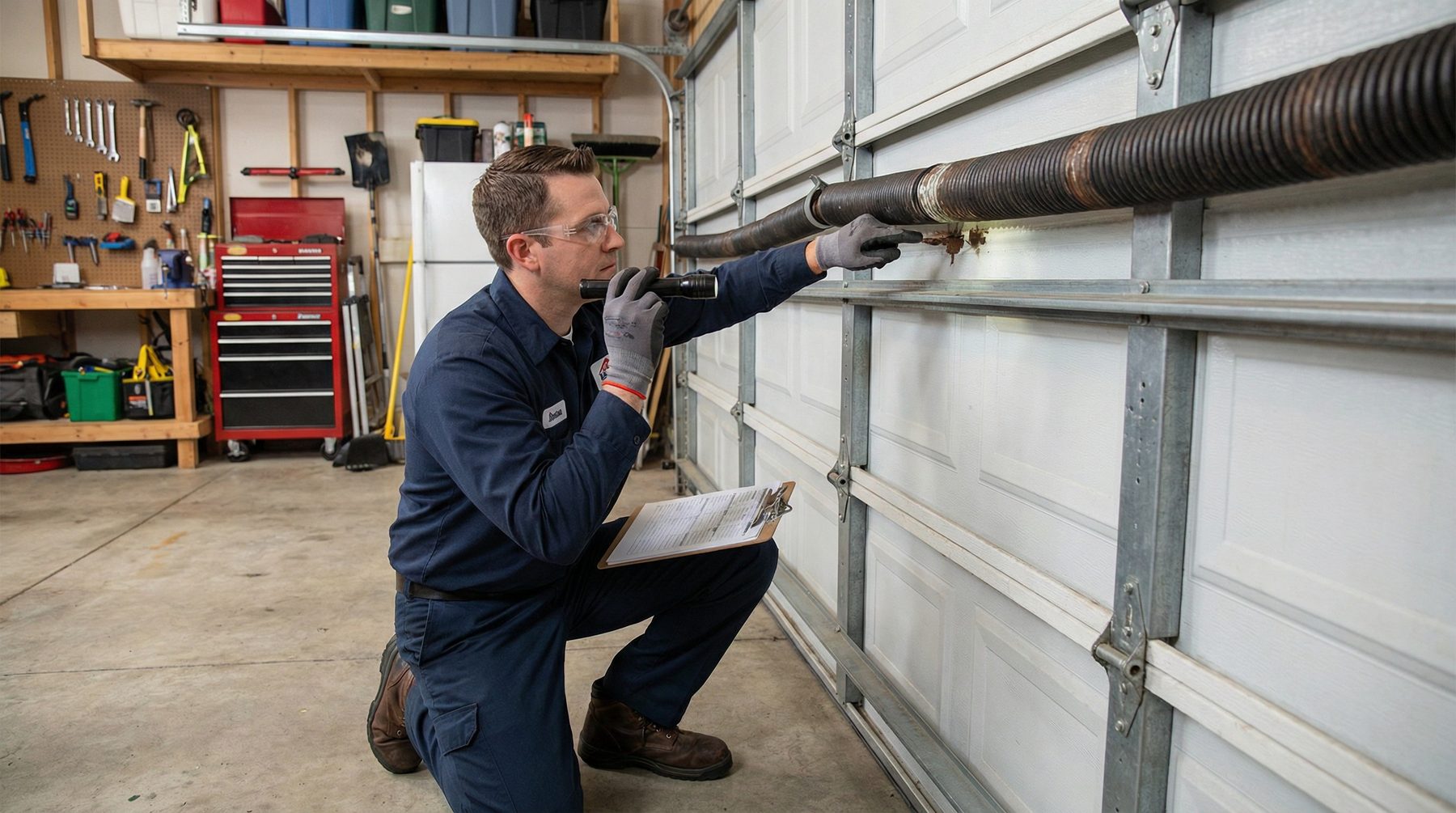
The last safe job is the most valuable one: looking. A monthly look at the springs, cables, rollers, and hinges from the floor, with a flashlight, catches problems months before they become emergencies. Look for a gap in a torsion spring coil, a slack cable, a wobbling roller, or a rattling hinge. It takes two minutes.
Safe to try
- Wipe the photo-eye lenses and check the beam is clear, with the door closed.
- Lubricate rollers, hinges, and the opener rail with a garage-door-rated product.
- Replace remote and keypad batteries.
- Clear grit, leaves, and dust from the tracks.
- Replace a torn or brittle bottom seal.
- Run the 30-second balance test on a normal-looking door.
- Look at springs, cables, and rollers from the floor, monthly.
Which repairs should you never attempt on your own?
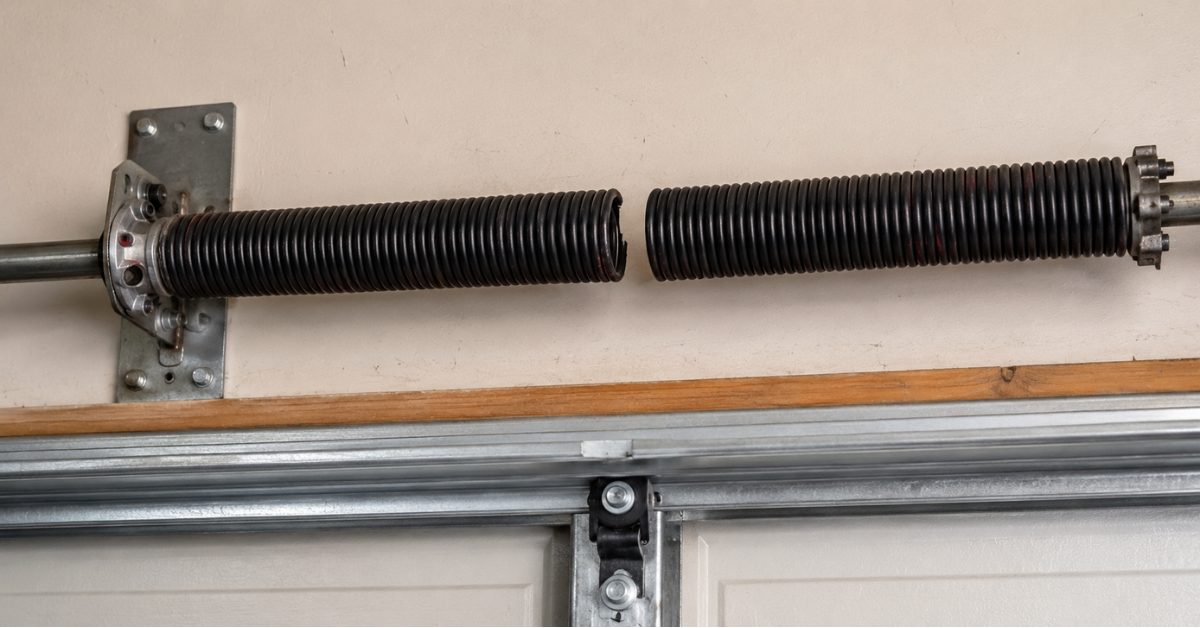
Some jobs are never DIY, no matter how clear the video tutorial looks. Springs are first. Torsion springs above the opening and extension springs along the tracks both store the full counterbalance force of the door. Adjusting or replacing one requires winding bars, a controlled release of tension, and a way to hold the door's weight while the spring is out. A screwdriver used as a winding bar is the most common cause of serious garage door injuries, because a screwdriver slips. If a spring has snapped, do not touch it.
Lift cables are second. They run from the bottom corners of the door up to the drums and carry the door's weight every time it moves. A cable that looks frayed, slack, or displaced from its drum may fail on the next cycle. Replacing one means working with the drum while the spring system is under tension, and a cable that lets go under load whips. If you can see a cable problem, the repair belongs to a technician.
Bottom brackets are third, and they surprise people. The small bracket at the lower corner of the door looks harmless, but it anchors the lift cable, so it holds the full tension of the spring system. Loosening a bottom bracket bolt is the same as releasing a cable under load.
Track work under tension is fourth. A bent or loose track needs realignment, but the door must be secured first and the spring tension accounted for before any track bolt is touched. Pushing an off-track door back into place by hand can drop or twist the door without warning.
Opener internals are fifth. Replacing a remote battery is safe. Opening the opener housing to work on wiring, gears, or the circuit board is not, and neither is changing the opener's force or travel limits to make a struggling door close. Force settings are a safety system, not a performance adjustment: turning them up defeats the auto-reverse protection. If the door needs more force to close, something else is wrong.
Stop and call a pro
- A spring has snapped, or you can see a gap in the spring coils.
- A cable is frayed, slack, looped, or off its drum.
- The door sits crooked, one side lower than the other, or it is off its track.
- The door is stuck open or partly open and will not move.
- You heard a loud bang from the garage and the door suddenly feels far heavier.
- The door drops quickly when released, or shoots upward on its own.
How do Colorado Springs winters change the DIY line?
The honest line between DIY and calling a technician moves with the seasons, and winter moves it further than most homeowners expect. The first winter shift is the freeze-thaw cycle: a January day on the Front Range can start below freezing and reach the fifties by afternoon. A door can freeze to the concrete slab overnight, and in the morning it looks exactly like a broken spring. Forcing a frozen door is how cables snap. Thaw it first with warm water along the bottom seal, and never pull the release cord or push the door while it is still frozen down.
The second winter shift is the sun. Colorado Springs sits above 6,000 feet with around 300 days of sunshine a year, and the low winter sun hits west-facing photo-eyes directly. A sensor alignment that works all summer can fail in January, when the sun blinds the receiving lens at the same hour every afternoon. Re-aiming the brackets works for a day, until a forty-degree daily temperature swing moves them again. If your door refuses to close only on winter afternoons, shade the receiving eye rather than re-aiming the hardware: the problem is light, not alignment.
The third winter shift is the lubricant. A door lubricated with the wrong product in November turns to paste by January, and a door that was smooth in autumn starts dragging and reversing in the depths of winter. The fix is still DIY: use only a garage-door-rated lubricant, applied sparingly, and wipe away the excess.
The fourth winter factor is the age of the housing stock. Much of Old Colorado City, Manitou Springs, and Security-Widefield was built before modern torsion systems became standard, and many of those homes still have extension springs with no containment cable. If one breaks, there is nothing to catch it. If your home is older and you are unsure which spring system you have, that uncertainty alone moves the job to the technician.
The fifth winter shift is the stranded car. On a freezing morning, a door that will not move at all is not a DIY moment. If a spring has failed in the cold, the full weight of the door is suddenly yours to hold, on an icy driveway, with the car still inside. If the car is trapped and the door will not move, that is a call to a technician, not a reason to try harder. A failed attempt can leave the door half-open with the car still inside.
What does a "simple" DIY fix cost you when it goes wrong?
The honest answer is that the cost is rarely the part. It is everything the part touches. A spring adjustment done with the wrong tool can bend a track, snap a cable, strip the opener's drive gear, and leave a door that was merely slow unable to move at all. The opener compensating for a weak spring often gives out first, because it has been carrying weight it was never built to carry.
There is also the warranty question. Many openers and doors carry coverage that depends on the work being done by a trained technician, and a homeowner repair can void it. The video tutorial never mentions this, or that a door fixed the wrong way can fail again on the first freezing morning of January, with the car inside. One more check before any visible change: if your HOA controls exterior appearance, a new panel or bracing may need approval first. Check before a DIY swap, not after.
The most expensive version of a failed DIY fix is the one that looks like it worked. A sensor re-aimed in the wrong direction, a force setting turned up to make a binding door close, a cable reseated without checking the drum — each can make the door move again while leaving the real problem in place. The door works for a week, then fails harder, with its safety systems defeated.
None of this argues against the safe jobs. Cleaning sensors, lubricating rollers, and clearing tracks keep a door running well for years. The argument is against the unsafe jobs, because the price of getting them wrong is a door more broken than when you started, a warranty that no longer applies, and a repair involving parts that were fine before you touched them.
How do you decide in 60 seconds: DIY or call a pro?
Stand in front of the closed door and ask three questions. First, does the job touch anything that holds the door's weight — a spring, a cable, a bottom bracket, or a track under tension? If yes, stop: that is the line, and it does not move with confidence or experience. Second, can the door drop, twist, or move on its own while you work? If it is stuck open, partly open, crooked, or off its track, the job belongs to a technician. Third, is the fix something you can undo? Cleaning a sensor can be undone. Loosening a bracket bolt cannot.
If all three answers point to safe ground, go ahead, take your time, and work from the floor rather than a ladder. If any answer is unclear, treat unclear as a no: a technician can tell you in a minute whether a job is yours or theirs.
The safe DIY vs never DIY line, stated plainly: safe for a homeowner means cleaning sensors, lubricating rollers and hinges with a garage-door-rated product, replacing remote batteries, clearing tracks, and replacing a bottom seal. Never DIY means springs, cables, bottom brackets, opener internals, force settings, and any track work under tension. Everything else is a judgement call, and the judgement should err toward the technician whenever you are in doubt.
What should you do right now if your door is stuck?
First, stop pressing the remote: every cycle with a stuck door strains the opener, the cables, and the tracks. Second, look, from the floor, without touching anything. Is there a gap in a spring? Is a cable slack or off its drum? Is the door crooked or off its track? Is there ice along the bottom seal? What you see decides what happens next.
If the door is frozen to the slab, thaw it: warm water along the bottom seal, worked patiently, will free it. Do not pry it up with a tool, and do not pull the release cord while it is frozen down. If the sensors are the problem, wipe the lenses, check the beam is clear, and look for low winter sun on the receiving eye. If the door is heavy, crooked, off its track, or you heard a bang, keep clear and call a trained technician. Do not stand under it, lift it by hand, or disconnect the opener.
If the car is trapped inside and the door will not move, resist the urge to force it. A door that will not move on a freezing morning is telling you something has failed, and forcing it is how a cable snaps or a door comes off its track. Keep the door where it is, keep people clear, and make the call.
What to read next
The honest line is simpler than the internet makes it look. Cleaning, looking, lubricating, and clearing tracks are yours. Springs, cables, brackets, and anything under tension are not. The 30-second balance test sits exactly on the safe side of that line: it changes nothing, and it tells you more about your door's health than almost anything else you can do yourself. Run it monthly, and when it tells you something has changed, let that be the moment you make the call.
Read our 30-second balance test guide before any repair decision, and our what to lubricate guide for what to touch and what to leave alone. Our garage door maintenance page covers the full monthly routine, and our homepage gives an overview of garage door services in Colorado Springs.
Questions homeowners ask about this topic
Stop before tensioned hardware
Do not unwind torsion or extension springs, loosen cable drums or bottom brackets, bypass photo eyes or push an off-track door into place. If the door becomes heavy, crooked or unsupported, keep people clear and use the emergency garage door repair guide.
Which garage door service pages should you read next?
Which related Colorado Springs guides add context?
Not sure what failed?
Describe what the door is doing, its current position and any visible damage. Same-day slots can fill fast, but timing is only confirmed after contact. Calls are answered 24/7 at (719) 403-0616.