
Disconnect the opener, lift the door to waist height, and let go. A balanced door stays where you leave it. If it slams down, drifts up, or feels heavy, the springs are no longer counterbalancing its weight, and the opener is doing work it was never built to do. Test monthly; never adjust a spring yourself.
A balanced door stays where you leave it; an unbalanced one slams, drifts, or feels heavy. This guide walks through the 30-second test, what each result means, and the safety gate to pass before you touch the release cord.
You press the remote and the door groans its way up, slower than it used to. Or one cold morning you lift it by hand and it feels twice as heavy as it did in the summer. Most homeowners blame the opener. The opener is usually innocent. The real problem is balance: the springs that are supposed to carry almost the entire weight of the door have quietly lost their strength, and the motor has been covering for them ever since.
The test that finds this takes thirty seconds and needs no tools. It catches a failing spring months before it snaps. This guide shows you exactly how to run it, what the results mean, the safety gate you must pass before you touch the release cord, and why balance is harder to keep on the Front Range than almost anywhere else.
Why does a garage door need to be balanced at all?
A residential garage door is heavy — a single steel door weighs roughly what two adults weigh. The trick is the springs. Torsion springs mounted above the opening, or extension springs running along the side tracks, store energy as the door closes and release it as the door opens. Properly set, they counterbalance almost the entire weight of the door, so the part you or the opener actually lift is only a small fraction of it. A balanced door feels like roughly ten pounds at the handle.
That balance is the whole design. The opener is not a lifting machine; it is a guiding machine. Its motor, rail, and drive gear are sized to move a balanced door, not to haul an unbalanced one. When the springs weaken, the weight they used to carry does not vanish — it transfers onto the opener, the cables, the rollers, and the tracks, and everything starts wearing faster than it was built to wear.
What does an unbalanced door actually do to your opener?
It kills it slowly, and the symptoms look like opener problems, which is why so many openers get replaced when the door was the fault. The first thing to go is usually the drive gear. Most residential openers use a nylon or plastic drive gear that is deliberately designed as the weak link — it strips before the motor burns out. An opener lifting an unbalanced door puts extra load on that gear every single cycle, twice a day, hundreds of times a month. The gear wears, the opener starts slipping and grinding, and eventually the motor spins while the door does not move.
The motor suffers next. A motor lifting more weight than it was built for runs hotter and longer, and on a warm afternoon in an uninsulated Colorado Springs garage it can reach its thermal cutoff and stop mid-cycle, then work again an hour later once it has cooled. That intermittent failure — works in the morning, stops in the afternoon — gets blamed on heat, on the remote, on the circuit board. Heat is often part of it, but the root cause is the extra weight. Cables fray faster, rollers flatten, and a door heavier on one side runs crooked in the tracks. A balance test costs thirty seconds. Replacing an opener, a set of cables, and a worn track costs a great deal more, and it still does not fix the springs.
Why is balance harder to keep in Colorado Springs?
Four local conditions make Colorado Springs doors drift out of balance faster than doors elsewhere.
The first is the freeze-thaw cycle. A Colorado Springs winter does not stay cold; it swings. A January day can start below freezing and reach the fifties by afternoon, and that swing repeats for months. Springs, cables, and tracks expand and contract with every swing, and steel fatigues a little with each cycle. The classic failure here is the spring that snaps on the first very cold morning of the season — already weakened by months of cycling, and the cold morning was the last straw. A balance test in late autumn catches the weakening before the cold morning finds it.
The second is the daily temperature swing. Even in summer, a Colorado Springs day can move forty degrees between dawn and afternoon. That swing changes the effective tension of the springs slightly through the day, stiffens lubricant in the morning and thins it by afternoon, and moves sensor brackets and track hardware by tiny amounts. A door that feels fine at noon can feel heavy at seven in the morning. Test at the same time of day each month — in the morning in winter, when the door is at its stiffest.
The third is hail and dust. Hail season on the Front Range runs roughly mid-April to mid-September, and a hailstorm does more than dent panels: it drives grit and debris into the tracks and onto the rollers, and a track full of grit makes a door bind. A binding door feels heavy and jerky in the hand, exactly like a spring problem. After a hailstorm, clear the tracks and wipe the rollers before you judge the balance. Monsoon dust does the same thing more slowly, filming the rollers and the sensor lenses through July and August.
The fourth is the houses themselves. Much of Colorado Springs — the subdivisions along Powers, in Briargate and Fountain, in Falcon, the older neighbourhoods near downtown and Old Colorado City — was built with uninsulated single-layer steel doors, and many have since been upgraded to insulated ones. An insulated door is heavier than the single-layer door it replaced, and a heavier door needs its springs set for that weight. If your door was replaced or insulated and the balance was never checked afterwards, this test is overdue.

What are the warning signs before you even test?
An unbalanced door advertises itself, if you know what to listen and feel for.
- The door feels heavier than it used to when you lift it by hand, or it falls quickly when you lower it.
- The door will not stay around the halfway point — it drifts down, or rises on its own after you start lowering it.
- One side of the door sits lower than the other, moves ahead of the other side, or looks crooked in the opening.
- The opener strains, jerks, sounds louder than normal, or reverses even when the safety sensors are clear.
- The door moves in a jerky, uneven motion instead of gliding smoothly, or it hesitates at the same height every time.
- The opener hums but the door does not move, especially on the first cold morning of the season.
- You hear a sharp bang from the garage, then the door suddenly feels far too heavy — a spring has likely snapped.
- The cables look loose, slack, or displaced from their drums, or you can see a gap in the coils of a torsion spring.
One symptom alone may be nothing; two or three together mean the test is overdue. Do not wait for the bang — the bang is the failure the test exists to prevent.
How do you run the 30-second balance test?
The test itself is simple, but the order matters, and there is a safety gate first. Never skip the gate.
First, pass the safety gate. Look at the door before you touch anything. Do not run the test — do not even disconnect the opener — if the door is stuck open or partly open, it sits crooked in the opening, a cable is loose, slack, frayed, or off its drum, you can see a gap or break in a spring, the door is off its track, a hinge or roller is visibly damaged, or the door has just made a loud bang. In any of those cases the spring system may no longer be supporting the door, and disconnecting the opener could let the door move under its own weight. Keep clear and call a trained technician. The test is for a door that looks normal and closes normally. If the door already looks wrong, you have your answer without testing.
Step one: close the door completely. The test starts from fully closed, with nobody and nothing under the door and the area around the tracks clear.
Step two: pull the red emergency release cord. The cord hangs from the opener trolley, usually with a red handle. Pull it straight down to disconnect the door from the opener. Do this only with the door fully closed and still — never pull the release while the door is moving.
Step three: lift the door by hand to about waist height. Use the handle on the inside of the door, or grip the bottom edge, and lift slowly and steadily. A balanced door should lift smoothly and feel light — roughly ten pounds at the handle.
Step four: let go, carefully. Stand to the side, not under the door, and release it gently. A balanced door stays where you leave it, or drifts only slightly. If it slams to the floor, the springs are too weak. If it shoots upward, they have too much tension.
Step five: test two more heights. Lift the door to about halfway, let go, and watch. Then lift it to about three-quarters open and do the same. A well-balanced door holds its position at every height. A door that holds at waist height but drops from higher up is losing balance as the springs unwind — still a failing system, just an earlier one.
Step six: lower the door fully and reconnect the opener. Guide the door down by hand — do not let it drop — and reconnect by running the opener once or pulling the release cord back toward the door until the trolley clicks in. Run the door up and down once with the opener to confirm everything is reconnected and moving normally.
That is the whole test. Thirty seconds, no tools, and you now know more about your door's health than most homeowners ever learn.

What do the results mean?
The door's behaviour when you let go is the diagnosis. Each result points to a different problem.
Stays put at every height. The door is balanced. The springs are carrying the weight as designed, and the opener is only guiding. Test again next month.
Drops quickly, or slams to the floor. The springs are too weak, or one has broken. The door's weight is no longer counterbalanced, and the opener has been carrying it. Stop using the door normally until a technician has inspected it. Do not keep pressing the remote — every cycle overheats the motor and wears the drive gear further.
Rises on its own, or drifts upward. The springs have too much tension, or the door has become lighter than the springs were set for — sometimes after a panel or insulation change. An over-tensioned door still stresses the cables and drums, and it can fly up unexpectedly. Keep clear and call a technician. Never try to release spring tension yourself.
Feels heavy, jerky, or catches at one height. This may not be the springs at all. A door that is heavy to lift but holds its position when released may be binding — grit in the tracks after a hailstorm, a bent track, worn rollers, or a loosened hinge. Clean the tracks and run the test again; if it still catches, a technician should find the cause.
One side moves ahead of the other, or the door sits crooked. This usually points to a cable or drum problem rather than spring tension — one cable carrying more load than the other, or a cable that has slipped its drum. Do not try to even it out yourself. A crooked door can come off its track, and that is a job for a trained technician.
Slight drift, an inch or two, then it settles. A small drift is common on older doors and is not an emergency, but it is a sign the balance is starting to go. Note it, test again in a month, and if the drift grows, book the inspection before winter. In Colorado Springs, a door that drifts in October is a door that may not lift on the first freezing morning of January.
How often should you test, and when in the year?
Monthly. The Door and Access Systems Manufacturers Association recommends monthly inspection and testing of the door and opener system. Pair it with the monthly auto-reverse test on the same day each month.
In Colorado Springs, test in the morning in late autumn, before the first hard freeze; after hail season, around late September, clear the tracks of grit first; and after any change to the door, since any change in weight changes the balance.
What can I safely check myself?
The test is a diagnosis, not a repair, and the checks around it are the same: look, listen, and clean, but do not adjust anything that carries spring force.
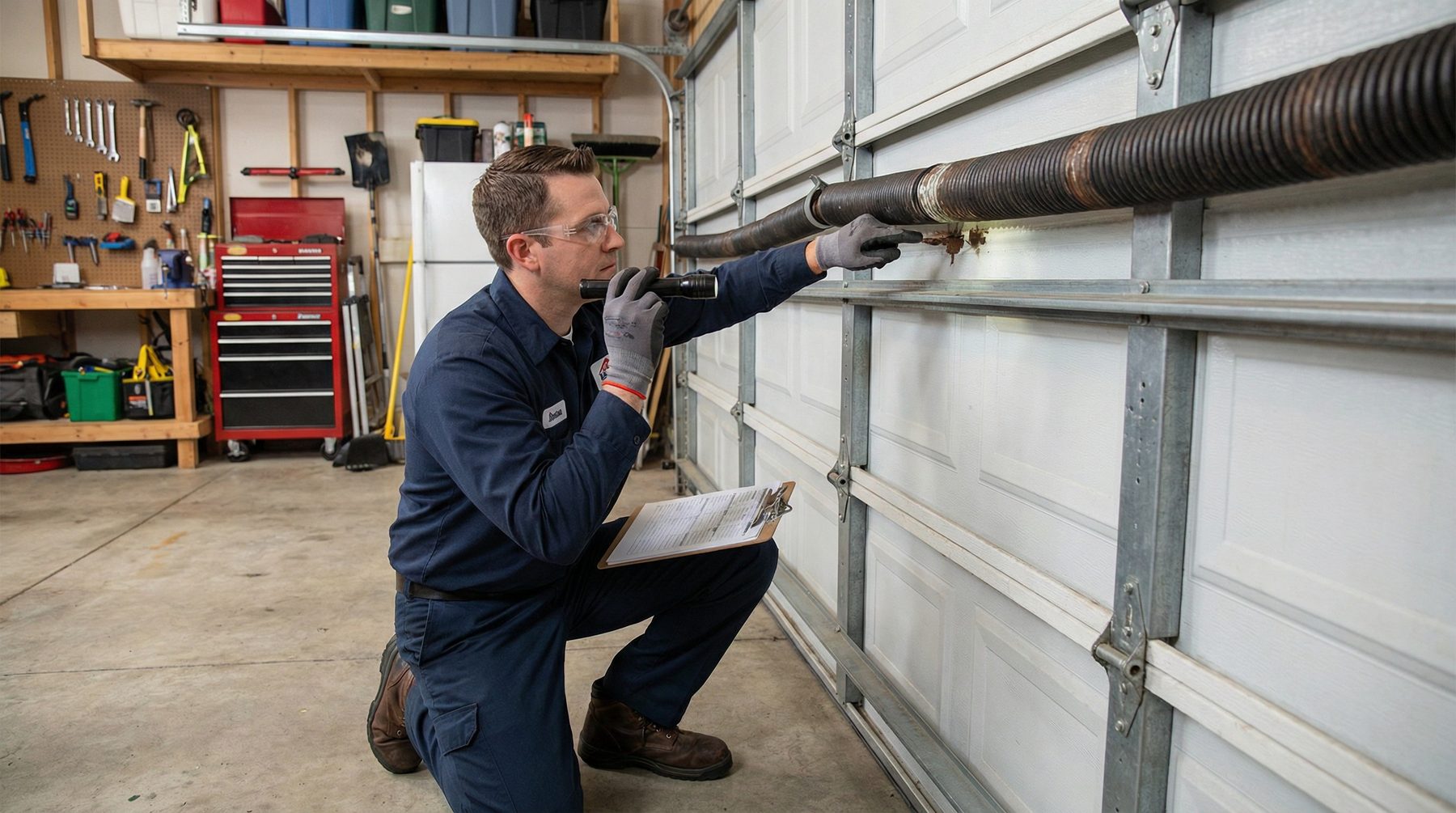
Look at the springs from the floor. With a flashlight, follow the torsion spring coil above the opening from one end to the other and look for a gap in the coils — a gap means a break. For extension springs along the side tracks, look for stretching, rust, or a spring that hangs unevenly. Look, do not touch.
Look at both cables. Follow each cable from the bottom corner of the door up to the drum. Both should be taut, sitting in their grooves, with no slack, no loops, and no fraying. If one is slack or off its drum, stop and call a technician.
Clear the tracks. Wipe out grit, leaves, and dust, especially after a hailstorm or a windy monsoon week. A clean track is part of the test — a door cannot balance true in a dirty track.
Lubricate the moving parts. With the door closed, apply a garage-door-rated lubricant to the rollers, hinges, and the opener rail, and wipe away the excess. Do not lubricate the tracks, and never use a heavy grease that stiffens in the cold.

Safe DIY vs never DIY: where is the line?
The balance test is safe for a homeowner precisely because it changes nothing: testing and looking are yours; adjusting anything under tension is not. Safe for a homeowner: running the balance test, wiping and realigning the sensor lenses, clearing grit from the tracks, lubricating rollers, hinges, and the opener rail, replacing the remote battery, and replacing the bottom seal. Never DIY: adjusting or replacing torsion or extension springs, loosening the bottom bracket bolts, reconnecting or replacing cables, adjusting the drums, or changing the opener's force or travel limits to make a struggling door close. Springs store an enormous amount of energy, and a winding bar or a cable that slips can release it in a fraction of a second. The test tells you the springs need attention. It never tells you to fix them yourself.
What about the worries that delay the call?
Three worries come up about a door that failed its balance test: safety, time, and disruption. All three point the wrong way. Safety is the reason to call, not the reason to wait: a door that slams down when released is a door that can fall, and a spring that is weakening is heading for the morning it snaps. Waiting does not make it safer.
Time is the second worry, and it is backwards: the November call is a single visit, and the door is running again the same day, while the January call comes after the spring has snapped on a freezing morning. Disruption is the third, and it is the smallest: you do not need to empty the garage. The thirty-second test you just ran is the hard part. The call is the easy part.
What to read next
If this test pointed to a spring problem, read our broken garage door spring symptoms guide and our how long garage door springs last in Colorado guide; our garage door maintenance service page covers the full monthly routine, and our garage door spring repair service page covers counterbalance work. Pair this test with our two-minute auto-reverse test, and read our what to lubricate on a garage door guide and our homepage for an overview of garage door services in Colorado Springs.
Questions homeowners ask about this topic
Stop before tensioned hardware
Do not unwind torsion or extension springs, loosen cable drums or bottom brackets, bypass photo eyes or push an off-track door into place. If the door becomes heavy, crooked or unsupported, keep people clear and use the emergency garage door repair guide.
Which garage door service pages should you read next?
Which related Colorado Springs guides add context?
Not sure what failed?
Describe what the door is doing, its current position and any visible damage. Same-day slots can fill fast, but timing is only confirmed after contact. Calls are answered 24/7 at (719) 403-0616.