
A homeowner safety check covers one observed cycle, photo eyes, track condition, perimeter seals, changed sounds and visible tensioned hardware — all without tools on the door. In Colorado Springs, repeat it after hail, a hard freeze or high wind. Stop if the door is heavy, crooked, unsupported or off track.
The heaviest moving object in most homes deserves a real safety check: one observed cycle, photo eyes, tracks, seals, sounds, and the parts never to touch.
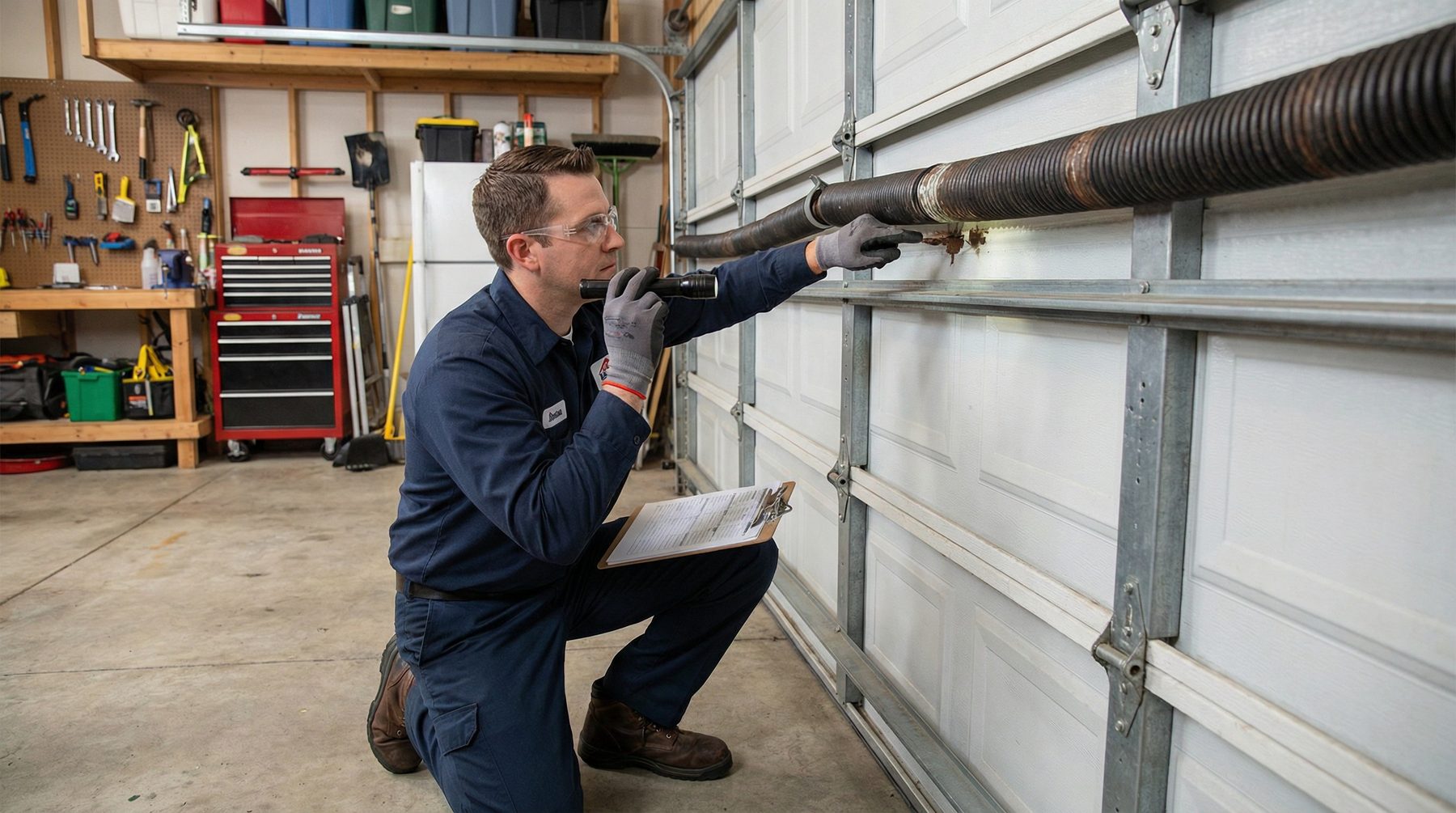
How do you observe one complete garage door cycle safely?
Every safety check on this page flows from one habit: watch the door work, from a safe position, with your full attention. Stand inside the garage, clear of the door’s path and clear of the tracks, keep children and pets out of the space, and run one complete cycle while you watch both sides equally. You are looking for symmetry — both edges rising together, rollers staying seated, sections folding evenly at the joints.
Specific faults announce themselves visually before they become failures. One side lagging the other points at the lift system. A roller edging toward the outside of its track is a door preparing to leave the track. A top section that flexes or bows as the opener pulls means the motor is doing work the springs should be doing. An opener whose pitch strains, slows or changes mid-travel is reporting resistance you may not see.
The rule that governs the whole check: what you observe decides whether you observe more. If travel is smooth, level and quiet, finish the cycle and move to the next check. If anything jerks, leans, scrapes or sounds newly wrong, stop the door, leave it where it is, and do not run a second cycle “to be sure.” A safety check that ignores its own findings is just wear with good intentions. In Colorado Springs, repeat this observation after any hailstorm, hard freeze or wind event strong enough to move patio furniture — the events that stress doors are the events this climate delivers regularly.
How should garage door photo eyes be checked?
Photo eyes are the small sensors mounted a few inches above the floor on both sides of the opening, and they are the door’s primary entrapment guard while closing. The check is simple and entirely homeowner-safe. Wipe both lenses with a soft, dry cloth — Front Range dust films them steadily — and clear anything stored within the beam’s path: bins, tools, sports gear and the recycling cart are the usual offenders. Confirm the indicator lights behave as your opener manual describes, typically steady when the beam is clear and aligned.
Then verify function the way the manual directs: start the door closing and interrupt the beam, and the door should stop and reverse. Do this test whenever sensors are cleaned, bumped, serviced or behaving oddly. Never bypass, tape over, disconnect or permanently block a photo eye to make a stubborn door close; a door that closes with its guard disabled is not fixed, it is disarmed.
Colorado Springs homeowners should know one local false alarm. On clear late afternoons, low sun can flood a west-facing sensor and blind it, so the door refuses to close even though the beam path is clean — then behaves perfectly after sunset. If your failures follow sunshine and clock time rather than obstacles, note the pattern before replacing parts; shading and alignment are different conversations from failure. The opener maintenance guide covers that sun problem in detail.
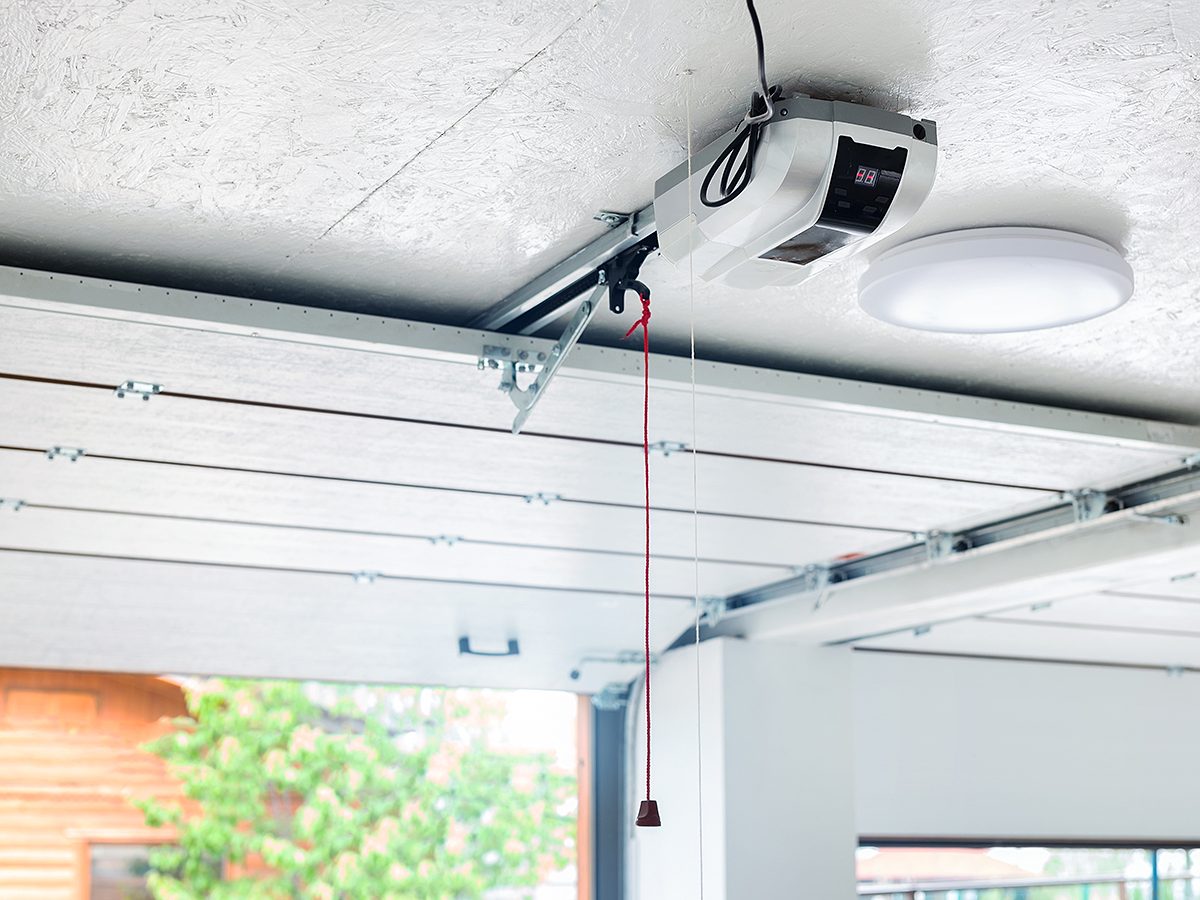
What track problems can be seen without adjusting hardware?
Tracks are the door’s rails, and you can learn a great deal about them with your eyes while touching nothing. With the door closed and the opener idle, look along each vertical track: it should run straight, sit firmly against its mounting brackets, and show no fresh dents, bends or shiny scrape marks where a roller has been riding wrong. Check that the curved transition into the horizontal track is smooth and that no bracket fasteners have visibly backed out.
During the observed cycle, watch the rollers inside the tracks. They should roll, centered, through the whole travel. A roller that wobbles, rides the track’s edge, scrapes at the same height every cycle or starts to climb out is a stop condition — end the cycle and leave the door down. Scraping at one repeatable height almost always marks the spot: a dent from a ladder or vehicle, a shifted bracket, a section edge contacting the track.
What you must not do is adjust. Track alignment involves loosening hardware that positions a heavy door under spring tension, and a track moved wrong can let the door out entirely. Clear loose debris from the track’s mouth if it is safe to reach with the door closed, and leave bolts, brackets and alignment to trained service. Observation is the homeowner’s tool here; it is genuinely powerful when you record what you saw and where.
How do seals and threshold conditions affect safety?
Seals sit at the meeting point of weather, water and the door’s moving parts, so their condition is a safety input, not just a comfort one. Start at the threshold: clear leaves, grit, ice and standing moisture so the bottom seal meets clean, dry concrete. A seal that freezes to the slab can tear on the next cycle or make the opener strain against a bonded door — and an opener straining against resistance is a safety problem in its own right.
Inspect the bottom seal and side weatherstripping by hand and eye. Supple rubber that springs back is doing its job; rubber that is cracked, flattened or brittle has stopped sealing and started trapping moisture against the bottom section and its hardware. In Colorado Springs that moisture is rarely clean water — it carries road treatment residue that corrodes bottom brackets and cable ends, the tension-carrying parts discussed throughout this guide.
Finish with the daylight test: door closed, garage lights off, look for light at the corners and edges. Even gaps suggest worn seals; uneven gaps suggest the door is no longer sitting square, which loops the finding back to tracks and lift hardware. Seals themselves are among the few parts a careful homeowner can replace — but the moment the work touches the bottom brackets beside the seal, it stops being a seal job, because those brackets hold cable tension. Keep that boundary bright.
Which changes in garage door sound should you record?
Sound is the earliest warning channel a garage door has, and a dated note turns a noise into evidence. You do not need technical vocabulary. Record four things: what it sounds like in plain words, where it seems to come from, where in the travel it happens, and what changed around the same time — a freeze, a hailstorm, a power outage, a vehicle bump.
Patterns worth recording promptly include popping that repeats at the same point in every cycle, grinding that is new or growing, squealing that follows cold nights, rattling hardware, and any change in the opener’s pitch. The most important entry in the log is a loud bang followed by a heavy door; that combination is the classic signature of a failed spring, and the correct response is to stop using the door entirely rather than to document it further.
Bring the log to any service conversation. “Grinding, left side, starts halfway up, began after the January freeze” lets a technician walk in nearly diagnosed, while “it got noisy sometime this year” starts the visit from zero. The same notes protect you: they show whether a problem is new, recurring or connected to weather, which matters when you later weigh repair against replacement. A phone note is enough. What matters is that the note exists before the sound becomes a failure.
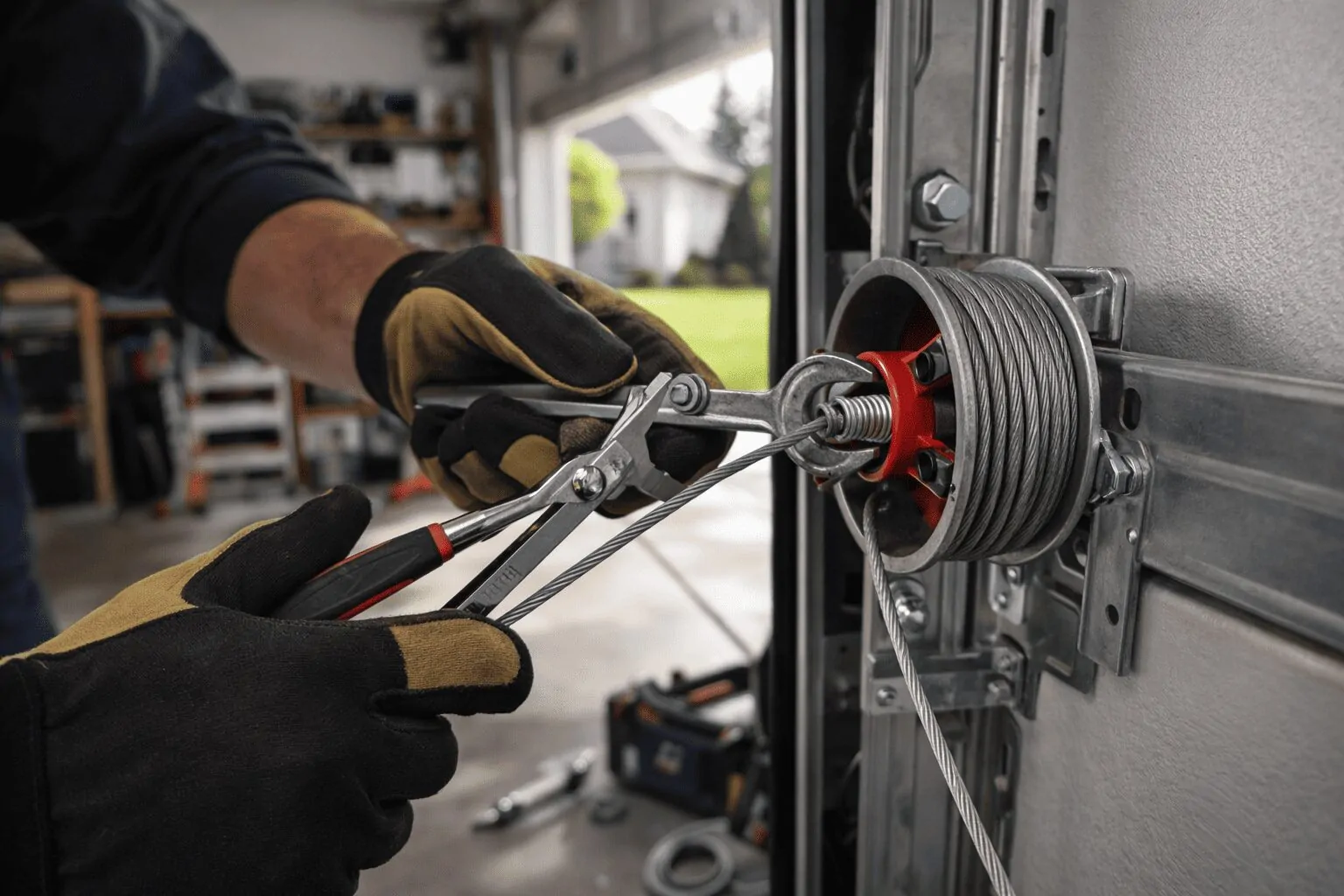
Which tensioned garage door parts are off limits?
This is the shortest check on the page and the only one with no gray area. Homeowners do not touch springs, lift cables, cable drums, winding bars or bottom brackets — ever, in either direction, tightened or loosened. These parts store and control the energy that counterbalances a door weighing well over a hundred pounds, and they hold that tension even when the door is closed, even when the opener is unplugged, even when the emergency release has been pulled. Disconnecting the opener disconnects the motor. It does not disconnect the springs.
Understand what the boundary protects you from. A torsion spring that unwinds uncontrolled can spin its winding bar with injuring force. A bottom bracket removed under cable tension can release a cable that whips. A door whose lift system is disturbed without the weight being secured can fall — and a falling sectional door does not give anyone time to step aside. These are not cautions copied from a manual; they are the reasons this work is trained work.
Your safe territory is everything else in this guide: observing travel, cleaning photo-eye lenses, clearing thresholds, checking seals by hand, testing reversal as the manual directs, and keeping notes. That is a real safety contribution — most failures are caught by an attentive homeowner long before they are fixed by anyone. When the finding involves tensioned hardware, the check is complete the moment you have identified it and stopped. The emergency repair guide explains what to do next when the door cannot be left as it stands.
How often should Colorado Springs homeowners repeat these checks?
Make the observation checks a monthly habit — they take minutes and pair naturally with things you already do, like taking bins out. Then add event-driven checks on top: after a Front Range hailstorm, after the first hard freeze and any threshold freeze, after a wind event strong enough to rattle the door in its tracks, and after any vehicle or ladder contact with the door or tracks. Changed behavior at any time outranks the schedule; a new sound or a heavier door earns a check the day it appears.
Once a year, hand the deeper layer to a professional: true spring balance, cable and drum condition under proper control, and hardware torque are not observation tasks. The professional maintenance visit provides that layer, and your own monthly notes make it faster and more accurate. Between the two rhythms — your eyes monthly, trained hands yearly — very little on a garage door gets to fail without warning.
When does a safety check become an emergency call?
A check becomes an emergency at the moment it finds a door that is no longer controlled: a spring with a visible coil gap, a cable loose or fraying, a roller outside the track, a section partly fallen or hanging at an angle, or an opening that cannot be secured closed. At that point the task changes from inspection to isolation — keep everyone clear, do not pull the release on an unsupported door, and do not try to muscle the door to the floor.
The emergency repair guide explains what information helps most while you wait: the door’s position, what you saw and heard, whether a vehicle is trapped, and whether the opening is secure. Your safety checks will have done their job even here — the failure was found by a person looking, in daylight and on purpose, instead of by the door itself at 6 a.m.
What does modern entrapment protection actually require?
Today’s safety expectations rest on a simple principle: a powered door must be able to detect trouble and reverse, through more than one method. Current openers are built around entrapment-protection standards such as UL 325, which is why your system has both photo eyes guarding the opening and a contact-reversal response if the door meets resistance. The two systems back each other up; neither is optional decoration, and a door whose opener predates photo-eye protection deserves an honest upgrade conversation with the opener repair guide as the starting point.
For the homeowner, the requirement reduces to upkeep: keep both systems functional, test them as the manual directs, and never defeat one because it is inconvenient. Storage creeping into the beam path, a sensor left misaligned after a bump, force settings raised to push a heavy door — each quietly unwrites the protection the standard exists to provide. Safety equipment only counts on the day it works.
How should these checks change in a home with children or pets?
Children and pets change the stakes of every check on this page, because they are smaller, faster and less predictable around a moving door than adults. Build the household rules first: the garage door is never a toy, the remote is never a plaything, and nobody walks under a door that is moving or held partly open. Wall controls should sit where an adult can see the whole opening while operating them — and out of easy reach of small hands where the layout allows.
Then adapt the routine. Run your monthly observation with children and pets inside the house, not watching from the garage, so the habit you are modeling is distance. Test the photo eyes and contact reversal exactly as the manual directs and on schedule, since those systems exist precisely for the household member who darts back for a forgotten ball or a wandering dog. Teach older children the stop rules that apply to everyone: never touch springs, cables or the bottom brackets, and never try to beat a closing door.
Finally, treat any failed safety test in a home with children or pets as urgent rather than routine. A door that reverses unpredictably, or a sensor that has been knocked out of line, should end automatic closing until it is diagnosed — the margin those systems provide is the margin your household actually uses.
Questions homeowners ask about this topic
Can homeowners test garage door balance themselves?
Only within the manufacturer’s manual and only when the door is not heavy, crooked or damaged. Springs and lift cables must never be adjusted by a homeowner; a door that feels wrong ends the test rather than starting a repair.
What should happen if a photo eye fails its test?
Stop automatic closing, clear the beam path, clean the lenses and follow the model-specific checks. Do not bypass, tape over or disconnect the sensor, and do not raise force to make the door close.
Does disconnecting the opener remove spring tension?
No. Springs, lift cables, drums and bottom brackets can remain under dangerous tension after the power is off or the trolley is released. Disconnecting the motor does not make the lift system safe to touch.
How often should these safety checks be repeated?
Monthly as a habit, and additionally after hail, a hard freeze, a strong wind event or any contact with the door. Changed sound, weight or travel at any time earns an immediate check regardless of the calendar.
A roller looks close to the edge of its track. Is that urgent?
Yes. A roller riding the track edge can leave the track entirely and let the door twist or fall. Stop cycling the door, leave it closed, and have the track, roller and lift system inspected before further use.
Stop before tensioned hardware
Do not unwind torsion or extension springs, loosen cable drums or bottom brackets, bypass photo eyes or push an off-track door into place. If the door becomes heavy, crooked or unsupported, keep people clear and use the emergency garage door repair guide.
Which garage door service pages should you read next?
Which related Colorado Springs guides add context?
Not sure what failed?
Describe what the door is doing, its current position and any visible damage. Same-day slots can fill fast, but timing is only confirmed after contact. Calls are answered 24/7 at (719) 403-0616.