
Before a Colorado Springs freeze, book an inspection when the door grows heavier, lifts unevenly, scrapes, changes the opener’s pitch, shows daylight at the perimeter, freezes at the seal or corrodes near the bottom hardware. Each sign points to spring, cable, roller, track or sealing wear that cold weather will punish.
Doors rarely fail without warning: they get heavier, louder and crooked first. Seven changes to catch before a cold snap becomes a no-open morning.
Why does a garage door suddenly feel heavier?
A door that feels heavier than it did last month is the single most reliable early warning a garage door gives. Weight change means the balance of the system has changed, and balance is the springs’ entire job. A heavier door usually points to spring fatigue first, with added track resistance or a developing cable problem as the other main suspects. Through the opener, heaviness sounds like strain: the motor slows, its pitch deepens, or the top section begins to flex as it is pulled upward.
The danger is that heaviness develops gradually. You adapt to it week by week, the opener compensates a little more each cycle, and the system borrows against parts that were not designed to carry the difference. Gears wear, the opener bracket stresses the top section, and the margin that kept everything safe quietly disappears. Then a cold morning stiffens the seal and thickens every lubricant, demand rises — and the tired spring that was “still working” finishes failing.
The response is discipline: the moment the door feels meaningfully heavier or the opener audibly strains, stop treating it as normal. Do not raise force settings and do not keep testing the opener to confirm it. Opener force should never substitute for a balanced lift system, and the spring repair guide explains what a proper balance restoration involves.
What does uneven garage door travel mean?
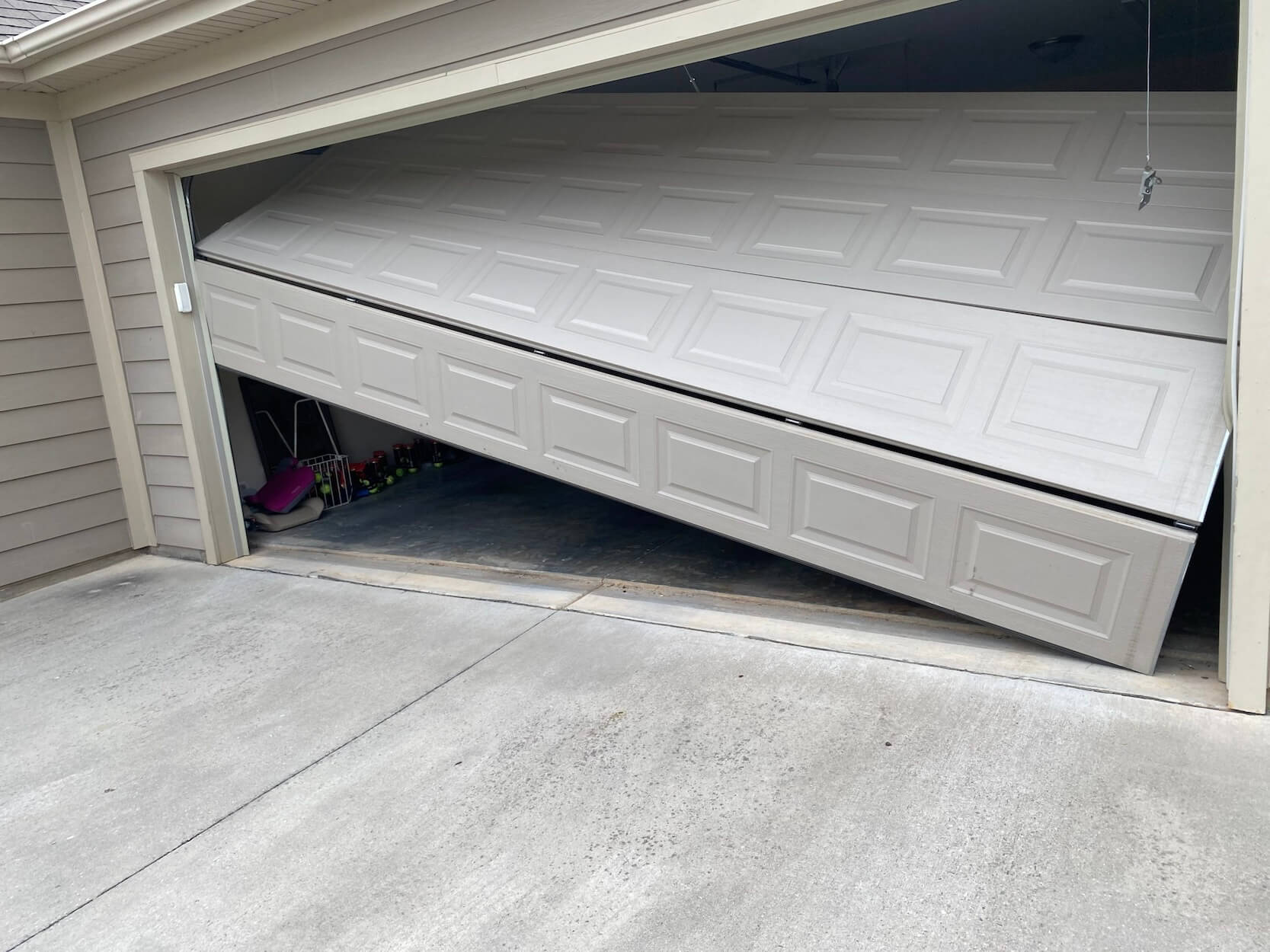
A door should rise as one level unit. When one side starts before the other, leans as it climbs, or settles crooked at the floor, something in the lift path has stopped sharing the work evenly. The usual suspects are a lift cable that is fraying, stretching or slipping on its drum, a roller that is failing on one side, or a track that has shifted. Uneven travel is a stop sign, not a quirk, because a crooked door can walk a roller out of the track entirely or twist a section in its opening.
Watch from inside with the door closed first: does one bottom corner sit higher than the other? Run one cycle only if the door still travels level, and end the test the moment lean appears. Note which side lags and whether it lags at the start of travel or partway up — a cable and drum problem often shows at specific heights, while a binding track shows at the same height every time.
Do not keep cycling the door hoping it straightens out; it will not, and each attempt loads the twist further. This is also a sign to read alongside the winter spring prevention guide, because uneven lift in October becomes a stuck, frozen, crooked door in January. Keep the door closed and unused until the lift system is inspected as a whole — cables, drums, rollers and springs together.
Which new garage door sounds need attention?
A garage door has a normal voice for your house, and you already know it. What matters is change. A single new sound is not a diagnosis, but a new sound is always evidence — of a part wearing, loosening or beginning to fail. Popping can come from spring coils binding against each other or from hinges working dry and worn. Grinding suggests rollers that no longer roll or gears inside the opener wearing down. Scraping at the same point in every cycle points to track alignment or a section contacting something it should clear.
Make the sound useful by noting three things: what it sounds like, where in the garage it seems to come from, and where in the travel it begins. A pop at the same height every cycle, a grind only in the last foot of closing, a squeal that follows cold nights — these patterns separate causes that a vague “it got loud” cannot. Sound that arrives with a visible change — heaviness, lean, a jerky start — outranks sound alone.
One combination is urgent rather than routine: a loud bang, especially overnight or in a cold snap, followed by a door that will not lift or feels dead heavy. That is the classic signature of a spring that has let go. Stop there — no more opener attempts — and treat it as the emergency repair situation it is.
Why does the garage door opener pitch change?
The opener is the door’s most honest reporter. Its motor note should be boringly consistent, cycle after cycle, season after season. When the pitch suddenly changes — deepens under load, wavers mid-travel, or rises into a whine — the motor is telling you the work changed. Most often, the door got harder to move: a tiring spring, a binding roller, a track that shifted, or resistance the motor now has to push through.
Work the simple checks first, in order. Confirm the photo eyes are clean and aligned, since a door fighting its own safety system can sound and behave oddly. Confirm power is stable. Then watch the door’s travel itself: is it level, does the top section flex, does one side lag? The opener’s voice plus the door’s movement together usually localize the problem — motor, drive or door.
Stop conditions are clear: if the door is heavy, jerky, crooked or cannot complete travel, end the experiment. Turning up force or travel settings to silence the complaint converts a warning into damage, and it can defeat the reversal behavior the safety system depends on. The opener maintenance routine in the opener maintenance guide shows how to sequence these checks through the year so a pitch change gets caught as information, not as a breakdown.
How can a frozen bottom seal damage the system?
The bottom seal looks like weatherstripping and behaves like a fuse. Through a Colorado fall, meltwater and sprinkler runoff collect at the threshold; the first hard freeze bonds the rubber seal to the slab. The next morning the opener pulls against a door that is glued to the concrete. Something has to give: the seal tears, the opener strains or stalls, or the bottom section takes stress it was not built for. Never use opener force to tear a frozen door loose.
The seal’s condition before the freeze decides how bad the morning is. A supple seal flexes and releases; a brittle, flattened or torn one bonds harder, leaks wind-driven dust all season, and lets more meltwater reach the threshold to freeze the next night. Walk the seal in October: squeeze it, look for cracks and splits, and check the corners where it meets the side weatherstripping.
Prevention is threshold housekeeping — clear leaves, grit and standing moisture before overnight freezes so the seal meets dry concrete, and keep driveway drainage moving away from the door. If the seal does freeze, free it patiently by hand and inspect before cycling. Replacement of a worn seal is one of the few genuinely homeowner-scale jobs on the door; anything involving the bottom brackets the seal sits beside is not, because those brackets carry cable tension.
What causes daylight around a closed garage door?
Close the door on a bright Colorado day, turn off the garage lights, and look at the perimeter. Light should not be streaming in. New daylight gaps mean the door or its seals no longer meet the opening squarely — and along the Front Range, every gap is also a door for wind, dust, pests and driven snow.
Separate the two causes, because their fixes differ. Worn perimeter weatherstripping and a flattened bottom seal create thin, even light lines along edges that still sit straight; that is a sealing problem. A section that no longer sits square — shifted tracks, a twisted panel after a vehicle bump, uneven cable tension — creates gaps that vary: wide at one corner, closed at another, often paired with travel that has changed. That is an alignment problem wearing a seal’s clothing, and new weatherstripping will not cure it.
On an attached garage, the stakes are comfort as much as weather. The garage buffers the rooms beside and above it; a leaky perimeter in a Colorado Springs winter means cold air against shared walls, a colder floor over the garage, and dust in everything stored there. Map the gaps while you inspect — which edges, which corners, even or uneven — and compare them with how the door travels. The pattern tells you whether you are looking at seals, alignment, or both.
Why is corrosion near bottom brackets a safety concern?
Of all seven signs, this one looks the most harmless and deserves the most respect. Rust blooming around the bottom of the door — on the bottom brackets, the seal retainer, the lower cable ends — reads as cosmetic aging. It is not. Bottom brackets anchor the lift cables and remain connected to spring tension at all times. Corrosion there weakens the exact hardware that keeps a heavy door controlled.
The cause is local and relentless. Colorado Springs treats winter roads, vehicles carry magnesium chloride slush home, and the melt pools at the coldest, lowest point of the garage: the threshold. Add meltwater from the driveway apron and the bottom few inches of the door live in a salty wet zone for months. Steel rollers, hinges and cable strands in that zone age years faster than the hardware at the top of the door.
The homeowner’s role is surveillance, not surgery. Photograph corrosion when you spot it, note whether it is spreading between checks, and watch for a cable that looks fuzzy with broken strands. Do not loosen, remove or wire-brush bottom brackets or cable hardware yourself — those parts stay under tension even with the door closed and the opener disconnected. Corrosion in the tension zone belongs in a professional inspection, where it can be assessed and replaced under controlled conditions.
Which warning signs make the door unsafe to use?
Five findings end the inspection and the door’s service until trained help arrives: a visible gap in a torsion spring coil, a lift cable hanging loose or frayed, a roller outside its track, a door hanging crooked or unsupported, and one side dropping faster than the other. Any one of these means the lift system is no longer controlling the door’s weight as designed.
Keep people, pets and vehicles clear, do not pull the emergency release on a door that may be unsupported, and do not run “one more cycle” to check. Review emergency garage door safety for how to secure the situation and what information to share when you call. Every other sign in this guide is an appointment; these five are a stop.
What should a pre-winter inspection cover?
A useful inspection works through the door as one system rather than hunting a single part. It covers spring condition and true balance; cable, drum and bearing condition; roller and hinge wear; track anchoring and alignment; the bottom seal and perimeter weatherstripping; threshold drainage; opener load and pitch; and both safety systems — photo eyes and contact reversal — tested as the manual directs. It also looks specifically at the bottom hardware for the mag-chloride corrosion described in this guide.
The maintenance and tune-up page explains how those checks fit together as a single visit. Ask for the findings in writing, including anything that was watched rather than repaired. A door that enters winter with a written baseline gives you something invaluable in January: the ability to tell at a glance what actually changed.
Why do these warning signs cluster in Colorado Springs falls?
The timing is not a coincidence. Colorado Springs usually meets its first hard freeze in October, but the setup begins weeks earlier: nights cool, seals lose their summer flexibility, and afternoon meltwater starts reaching the threshold. Doors that coped all summer on thinning margins meet rising resistance from three directions at once — stiffer rubber, thicker lubricant, and steel that contracts in the cold — while springs are another season older.
Housing stock adds to the pattern. Many Colorado Springs garages were built for lighter, uninsulated doors and later fitted with heavier insulated replacements, sometimes on springs that were only approximately matched. Those systems work for years and then announce themselves all at once when winter raises the effort required. A fall walk-through with this guide takes twenty minutes; it converts the season’s first failure from a surprise on a workday morning into a planned repair on a mild afternoon.
Questions homeowners ask about this topic
Is a suddenly heavy garage door safe to test again?
No. A heavier door can indicate spring fatigue or cable trouble. Stop the opener, keep clear, and do not repeat cycles to confirm it — each attempt adds load to parts that are already signaling distress.
Which garage door sound is most urgent before winter?
A loud bang followed by a heavy door, cable slack, crooked travel or a roller outside the track is urgent. Routine rattle or a mild new squeak is appointment-level; the bang-and-heavy combination means stop using the door.
Can new perimeter daylight be only a seal problem?
It can, if the gaps are thin and even along straight edges. Gaps that vary by corner, or that arrive with changed travel, point to shifted tracks or a section no longer sitting square — an alignment problem, not just weatherstripping.
Why does my opener sound strained only on cold mornings?
Cold stiffens the bottom seal, thickens lubricant and contracts metal, so the door needs more force exactly when the system has the least margin. A strain that follows temperature is the door reporting rising resistance.
Should I raise the opener force to get through winter?
No. Added force masks the mechanical problem, wears the opener and top section, and works against the safety reversal the system depends on. Restore balance and free travel instead of asking the motor to overpower resistance.
Stop before tensioned hardware
Do not unwind torsion or extension springs, loosen cable drums or bottom brackets, bypass photo eyes or push an off-track door into place. If the door becomes heavy, crooked or unsupported, keep people clear and use the emergency garage door repair guide.
Which garage door service pages should you read next?
Which related Colorado Springs guides add context?
Not sure what failed?
Describe what the door is doing, its current position and any visible damage. Same-day slots can fill fast, but timing is only confirmed after contact. Calls are answered 24/7 at (719) 403-0616.