
A garage door shakes when something in its travel path is loose, worn, bent or out of balance. Shaking at one spot points to the track or a roller; shaking all the way up points to rollers or hardware; tilting points to springs or cables — and that pattern means stop using the door and keep clear.
A garage door that shakes, jerks or shudders on its way up is telling you something specific — the pattern points at the part. This guide matches each pattern to its likely cause, separates safe DIY checks from the hardware you should never touch, and explains why Colorado Springs conditions make marginal doors shake first.
It is 7:40 on a work morning, coffee in one hand, keys in the other, and the garage door — reliable for years — climbs three inches, shudders, jerks sideways and rattles up like it is thinking about coming off its tracks. You stand in the driveway doing the maths every homeowner does: is it about to jam shut with the car inside? Could it fall? Can it wait until the weekend?
A shaking door deserves attention, but it rarely deserves panic. A garage door has a short list of moving parts — rollers, hinges, tracks, springs, cables and the opener — and each produces a recognisable shake when it starts to fail. Learn to read the pattern and you can name the likely cause, judge whether the door is safe to keep using, and know which checks are yours and which belong to a technician.
How can you tell what kind of shake your door has?
Watch one full cycle from the side of the garage — never from underneath the door — and note where the shake happens. The pattern is the diagnosis. Five patterns cover almost every shaking door:
- Shake only at the very start of travel. The door lurches as it leaves the floor, then settles: the lift system taking up load — springs and cables as they start carrying the door's weight, a bottom seal stuck briefly to the slab, or an opener starting against a door heavier than it should be.
- Shake at the same spot every time. A jolt at the same height every cycle is local, not general: a dented or pinched track, a damaged roller passing the same point, or one hinge binding as its section rounds the curve.
- Shaking through the whole travel. A tremor from floor to ceiling points to parts in contact the entire way — worn rollers, loose hinges and brackets, dry bearings dragging instead of spinning.
- One side rising faster, or the door tilting. The serious pattern. Uneven lift means the two sides no longer share the load: a weakening spring, a stretched or slipping cable, or a roller out of its track. Stop using the door if you see this.
- Shaking only when closing. Trouble on the way down but not up suggests the opener is pushing against resistance that gravity used to hide — a binding track, a stiff hinge, or force settings that no longer match the door.
Note your pattern before reading on — it tells you which of the cause sections below deserves your closest attention.
Could loose hardware be making your door shake?
A garage door is held together by dozens of bolts, and every cycle it runs vibrates all of them. Over months and years, that vibration backs fasteners out a fraction of a turn at a time — a hinge bolt here, a roller bracket there, a track bolt where the rail meets the wall. Together they let sections flex, rollers wander in their brackets and panels knock against each other as the door moves, and what you see from the driveway is a door that trembles and rattles through its travel.
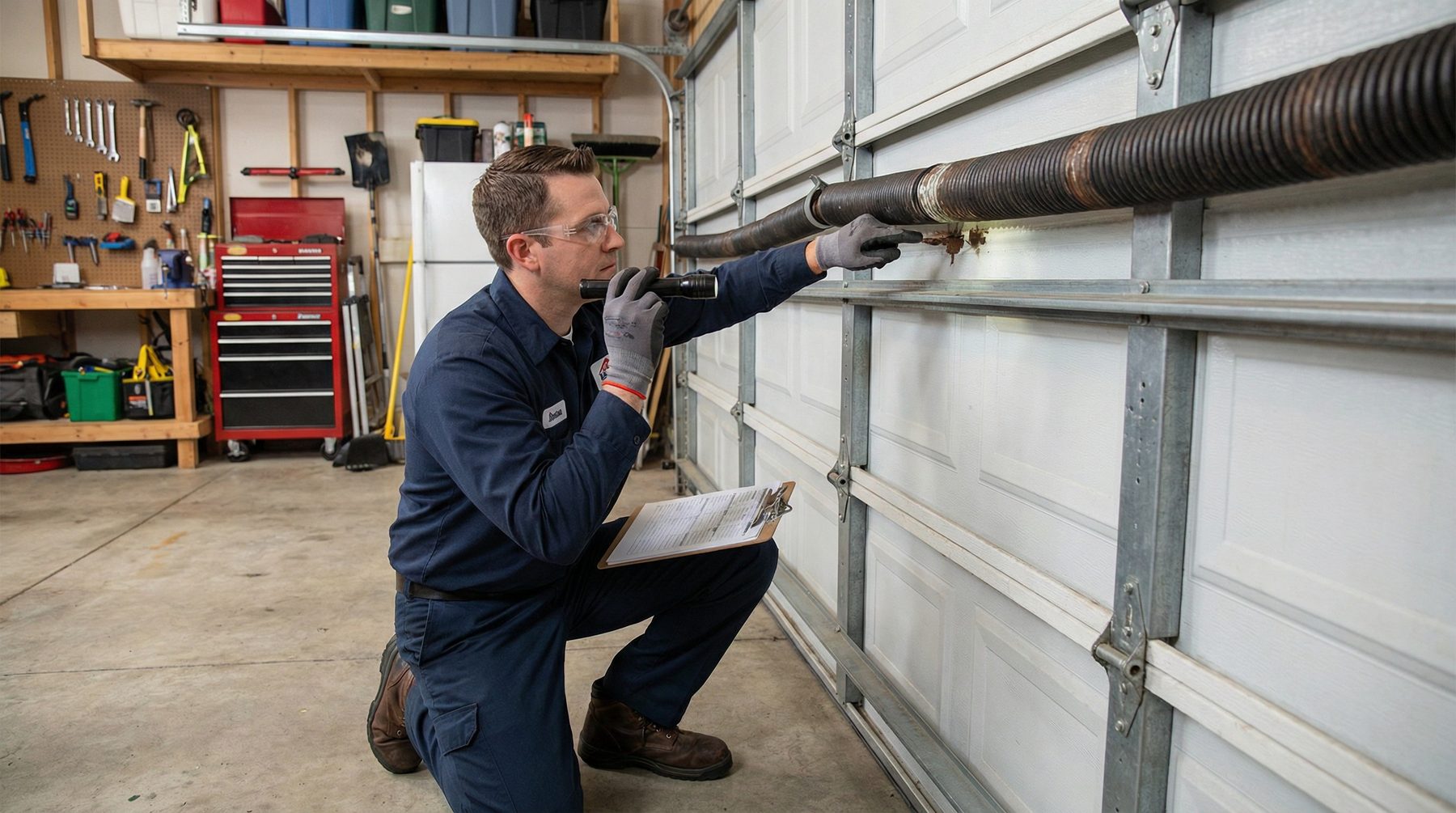
The signs are visible if you look with the door closed and the opener off. Sight along each hinge line: a hinge sitting proud of its neighbours, a bolt head ringed with bright fresh metal, or a gap opening between section and hinge are all tells. A roller that wobbles in its bracket as the door passes is riding loose. Track bolts should be snug, and the track itself should not flex when the door passes.
Tightening reachable bolts is a legitimate homeowner check, covered below. But hardware that keeps loosening is a symptom as much as a cause: something else — worn rollers, a binding track, an unbalanced door — is shaking it loose, and tightening alone will not hold.
Are worn or damaged rollers the cause?
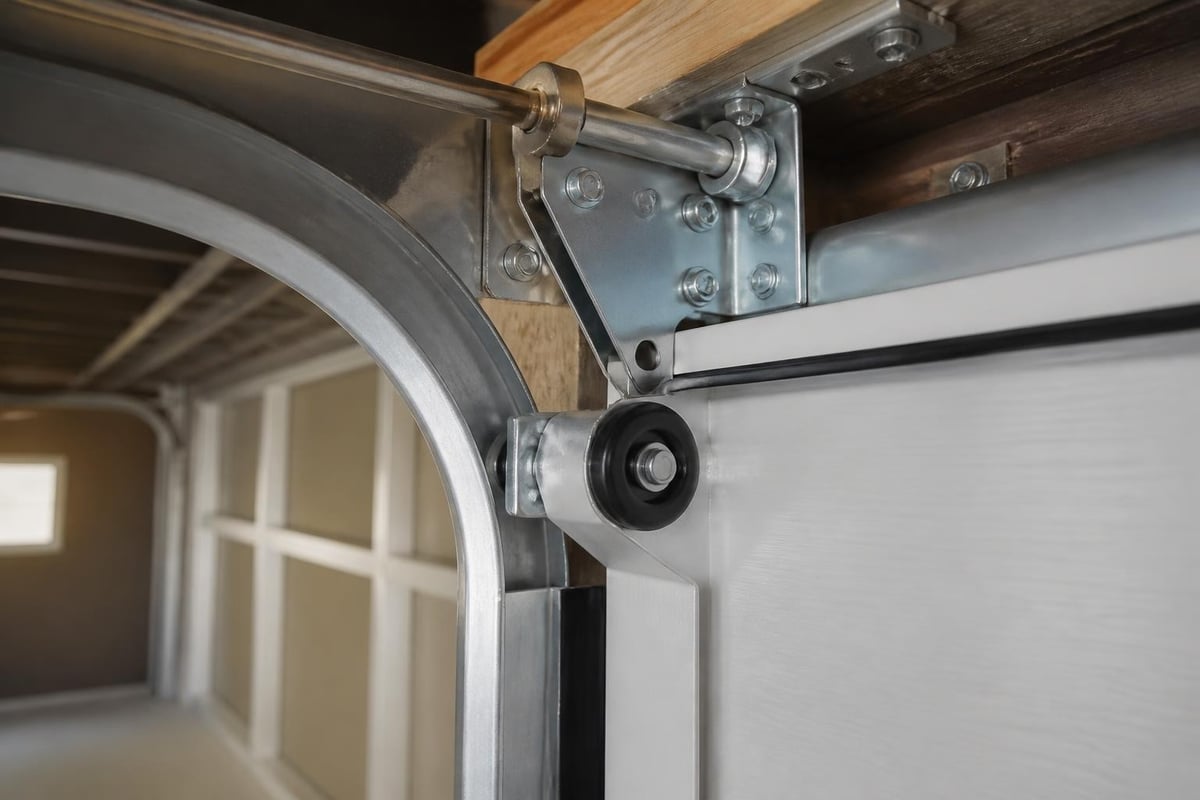
Rollers are the door's wheels — small wheels on stems that ride inside the tracks and carry the door around the curve from vertical to horizontal. When they are round, free-spinning and intact, the door glides. When a roller cracks, chips, or wears a flat spot, it stops rolling and starts thumping: once per revolution it catches, drags and releases, and the whole door shudders in time with it. A roller whose bearing has seized drags the entire way, adding a grinding tremor throughout.
Material matters here. Steel rollers are durable but transmit every imperfection straight into the door — a worn steel roller is loud and harsh. Nylon rollers run quieter and absorb more, but the nylon tyre can crack, split or wear flat, especially under heavier doors, and a split tyre lets the wheel wobble on its bearing. The check is visual either way: with the door closed, look at each roller in turn. Cracks, chips, flat spots, a wheel crooked on its stem, or heavy rust are all end-of-life signs.
One caution: the bottom roller bracket on most doors is part of the lift system and sits under spring tension. Looking is safe; removing rollers — especially the bottom pair — is not a homeowner job, which is why our garage door roller replacement page treats inspection and replacement as different things.
Is the track bent, dented or out of alignment?
The tracks only work when they are straight, parallel and evenly spaced. A door that shakes at the same point in every cycle is often reporting a track fault at exactly that height: a dent from a bumper or a ladder, a section of rail pinched inward, or a bracket that has let one rail drift out of line. The roller reaches the flaw, binds or drops into it, and the jolt runs through the whole door.
Two more checks help. First, sight up each track with the door closed and compare the gap between roller and rail on both sides. One side tight, the other floating, means the rails are no longer parallel, and the door is squeezed and released as it travels. Second, watch a hinge line as the door rounds the curve — a hesitating section often traces back to track alignment at the curve.
One rule is absolute: never try to hammer a track straight. The rail is a shaped channel, not a bar; hammering changes its profile in ways the eye cannot judge, can loosen its brackets, and can leave a roller ready to climb out under load. A bent track is measured, aligned and secured — or replaced — with the door supported, and that is technician work.
Is the door out of balance because of springs or cables?
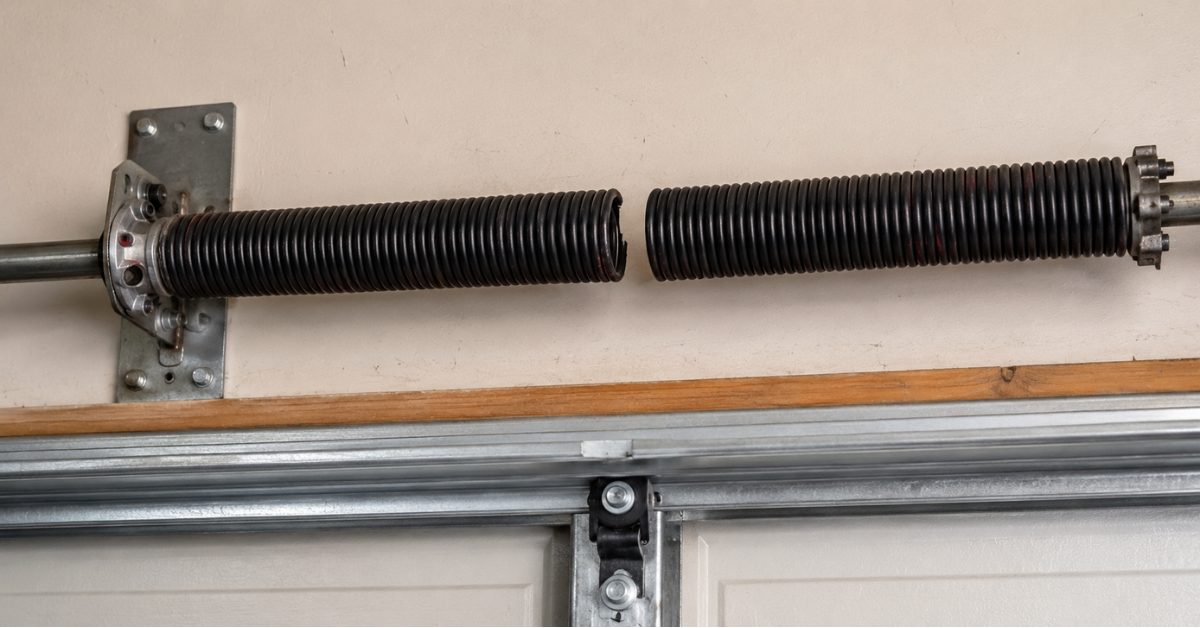
Springs and cables do the actual lifting. The opener only guides a door that its springs have already made nearly weightless, each side carrying an equal share. When one spring loses tension — through fatigue, corrosion or early failure — or a lift cable stretches, slips on its drum or frays, the two sides stop sharing the load evenly. One side rises eagerly, the other lags, the door racks sideways in its tracks, and the opener jerks against the uneven resistance instead of pulling smoothly. The result is the tilting, lurching shake from the diagnostic section — the pattern to take most seriously.
This is also where a shake can turn dangerous. A door lifting unevenly can walk a roller out of its track. A cable that lets go drops its side of the door. Because the springs hold the door's full weight as stored energy, this system cannot be tested by loosening or adjusting a component — the check is watching the door travel and how it sits at rest, never touching the hardware. Our guide to the symptoms of a broken garage door spring lists the companion signs — a visible coil gap, a suddenly heavy door, a bang from the garage — that confirm the lift system is involved.
Is the opener straining or are its settings off?
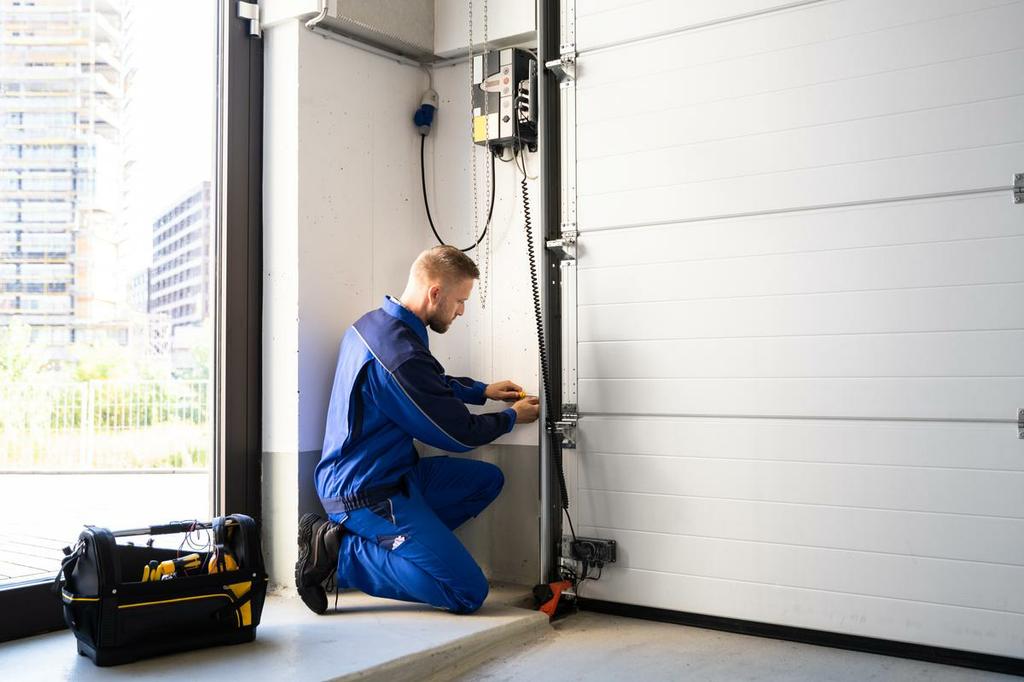
Sometimes the door hardware is honest and the shake starts above it. An opener moves the door through a rail and a drive — chain, belt or screw — and wear in those parts shows up as lurching. A chain that has stretched slack slaps and grabs: the motor starts, the slack takes up with a jerk, and the door shudders at the start of every cycle. Worn drive gears or a tired belt add hesitation and vibration through the rail, and a rail whose header bracket has worked loose flexes visibly while the door moves.
Settings matter too. Openers have force settings that decide how hard the unit pushes or pulls before it assumes an obstruction. Set too high, it powers through binds and tight spots instead of hesitating, turning a small track flaw into a whole-door lurch — and overriding a safety behaviour. Force and limit adjustments belong to the manufacturer's manual for your model, in small changes only: settings that suddenly need to sit far from where they were are reporting a door problem, not asking to be dialled away. If your door has also taken to groaning and rattling, our sound-by-sound guide to why a garage door gets loud pairs well with this one — noise and shake usually share a cause.
Why do garage doors shake more in Colorado Springs?
Every cause above exists everywhere, but Colorado Springs adds a local load that pushes marginal doors into shaking sooner — the classic local report: fine last night, shuddering this morning.
Freeze-thaw and cold mornings. Front Range weather swings across freezing repeatedly all winter, sometimes within a single day. Lubricant flowing in the afternoon stiffens overnight, so merely dry rollers and hinges are briefly seized at 7 a.m., then free up as the day warms — why a shake can vanish by noon. The cycling also fatigues steel springs: repeated cold contraction on top of daily use ages coils faster than steady cold, and a spring coping in October loses tension by January.
Hail. Colorado Springs is hail country, and steel panels take the hits. A dent that looks cosmetic can crease a panel edge or shift a section enough to bind at a hinge or pinch against the track — a shake at one repeatable point that was not there before the storm.
Mag-chloride de-icer. The magnesium chloride sprayed on roads and splashed up from driveways corrodes exactly the hardware that keeps a door smooth: tracks, hinges, roller stems, and the bottom brackets and cable ends nearest the floor. Over successive winters it pits steel, stiffens rollers and weakens cable strands, so its shake arrives gradually and gets blamed on age.
Dry air, daily swings and heavier doors. At altitude the air is dry and the daily temperature range wide, so framing and fasteners expand, contract and dry through constant swings — bolts snug in one season walk loose in another, the loose-hardware shake on a local schedule. And the city's housing stock carries heavier insulated doors than it once did: more weight on aging hardware means less margin, so the first worn part announces itself as a shake instead of a sound.
What is safe to check yourself — and what should you never touch?
The line is simple: eyes, a cloth, a wrench on reachable fasteners, and the right lubricant are yours. Anything that holds the door's weight or its spring tension is not.
- Safe: watch and listen. Run one full cycle and observe from the side — where the shake starts, whether it repeats at one spot, whether the door tilts.
- Safe: visual inspection, door closed. Check rollers for cracks and flat spots, hinges for gaps, tracks for dents and debris, cables for visible fraying — looking only, from a normal standing position.
- Safe: clean the tracks. Wipe grit, leaves and de-icer residue out of the track channels with a cloth. Do not pack tracks with heavy grease, which collects more grit.
- Safe: tighten reachable bolts. Snug loose hinge and track-bracket bolts you can reach easily with both feet on the floor, without standing under a raised door. Firm, not forced.
- Safe: lubricate moving parts. Apply a proper garage-door lubricant — not heavy grease — to roller bearings, hinge pivots and spring coils.
Never: do not touch springs, lift cables, spring brackets or bottom brackets; do not force a door back onto its track; and never stand under a door that is jammed, tilted or hanging unevenly. Those parts hold a raised door's weight as stored energy, and releasing it accidentally is how garage doors injure people.
What should you do right now if your door is shaking?
If your door is shaking today, work through this in order:
- Stop using the door if it tilts as it travels, hangs unevenly at rest, has a visibly frayed or slack cable, or has a roller out of its track. Park outside, keep people and pets clear, and do not run one more cycle just to check.
- Leave the opener connected unless the door is fully closed — only then is disconnecting it a safe option, and only if you can reach the release without standing under the door. A disconnected door with a lift problem can be far heavier than expected.
- If the shake is mild and the door runs level, do the safe checks in the section above — clean, look, lubricate — and watch the next few cycles from the side.
- Make three notes before any visit: when the shake happens (start, same spot, or all the way), where it is worst, and whether cold mornings make it worse. Those notes are half the diagnosis.
When you are ready, you can request service with those notes in hand — they tell the technician which parts to inspect first.
Will a shaking door fix itself or get worse if ignored?
It will not fix itself, because a shake is not a mood — it is a mechanical system travelling under uneven stress. A worn roller does not round itself back out. A bolt shaken loose today is looser next month. A door lifting unevenly wears its tracks, cables and opener a little more with every cycle, and the failure it heads toward rarely schedules itself politely: doors jam shut on work mornings, stick half-open in storms, or drop a side without warning.
The counterweight: most shakes are diagnosed in a single visit, and most causes — worn rollers, loose hardware, a track out of alignment — are contained repairs once connected parts are checked. The visit is short compared with a morning trapped behind a door that will not open, and a door left safe and level is the real outcome. If what you found in this guide matched a safe check, do the check and watch what happens. If it matched a stop sign — tilt, frayed cable, roller out of track — believe it the first time.
What to read next
If this guide pointed to worn rollers or travel hardware, our garage door roller replacement service page explains how roller and track problems are diagnosed and what a visit covers. The Colorado Springs garage door repair homepage gives the full picture of services, and the related guides below go deeper on neighbouring symptoms.
Questions homeowners ask about this topic
Why does my garage door shake only at the start of opening?
Because the start of travel is when the lift system takes up the door's full load. A bottom seal stuck briefly to the slab, stiff cold-morning lubricant, a slack opener chain taking up with a jerk, or springs no longer carrying their share can each produce a first-few-inches lurch that settles once the door is moving.
Why does my door shake at the same spot every time?
A shake that repeats at the same height is local damage, not general wear. The causes sit at exactly that point: a dented or pinched track, one cracked or flat-spotted roller passing the same flaw, or a hinge binding as its section rounds the curve.
Can I keep using a garage door that shakes?
A mild shake with the door running level can usually wait for a booked visit, watched closely. Stop using the door if it tilts, hangs unevenly, has a frayed cable, or has a roller out of its track. Those signs mean the door is no longer supported, and every extra cycle adds risk.
Does a shaking door always mean a spring problem?
No — springs are one cause among several, and not the most common. Loose hardware, worn rollers, a bent track and opener wear all shake a door with no spring involvement at all. Spring and cable trouble announces itself differently: the door tilts, rises unevenly, or becomes noticeably heavier.
Why does my garage door shake more on cold Colorado mornings?
Cold stiffens lubricant in rollers and hinges overnight, so merely dry parts are briefly seized at the first cycle. Freeze-thaw cycles also flex fasteners and fatigue aging springs across a Front Range winter. A door shuddering at 7 a.m. and smooth by noon is showing you a marginal part, not imagining it.
What should I check before calling for a garage door repair?
Watch one full cycle from the side and note the pattern: where the shake starts, whether it repeats at one spot, and whether the door tilts. Then look — without touching tensioned parts — for cracked rollers, loose hinges, track dents and frayed cables. Those notes turn a visit's first minutes into diagnosis, not guesswork.
Stop before tensioned hardware
Do not unwind torsion or extension springs, loosen cable drums or bottom brackets, bypass photo eyes or push an off-track door into place. If the door becomes heavy, crooked or unsupported, keep people clear and use the emergency garage door repair guide.
Which garage door service pages should you read next?
Which related Colorado Springs guides add context?
Not sure what failed?
Describe what the door is doing, its current position and any visible damage. Same-day slots can fill fast, but timing is only confirmed after contact. Calls are answered 24/7 at (719) 403-0616.