
A loud garage door is usually one worn, dry, or loose part asking for attention. Squealing means dry hinges or rollers, grinding means worn rollers or a rubbing track, rattling means loose hardware, and a single loud bang usually means a broken spring. Lubrication and tightening fix the simple cases; spring, cable, and track work is never a DIY job.
A garage door rarely gets loud for no reason. Every squeak, grind, rattle and bang points at a different moving part — and a different level of urgency. This guide matches each sound to its likely cause, separates the safe homeowner checks from the jobs that are never DIY, and explains why Colorado Springs weather turns quiet doors loud.
It is the sound that starts the day now. The garage door that used to hum quietly on its way up has begun to squeal, rattle and grind loudly enough to wake the house at 6 a.m. Visitors hear it from the driveway. You hear it from the bedroom, and underneath the annoyance sits a quieter worry: is it about to break, and is it still safe to use?
Take the noise seriously, but do not fear it. Noise is information. A garage door has only a small set of moving parts — springs, rollers, hinges, cables, tracks and the opener — and each part makes a different sound when it starts to fail. Learn those sounds and you can name the likely cause, judge how urgent it is, and know which checks are safe to do yourself. That is what this guide walks through, sound by sound.
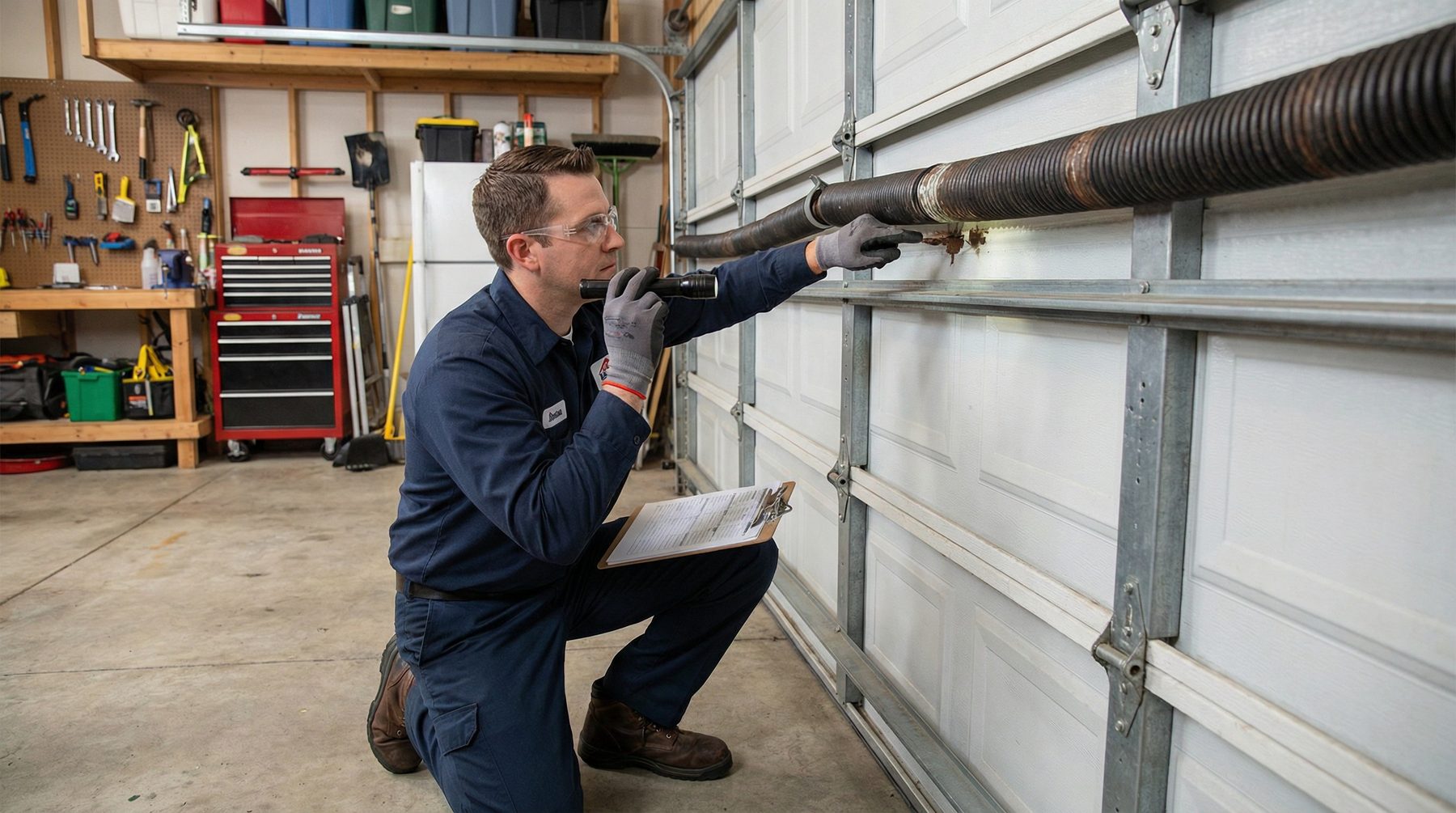
Why did my garage door suddenly get so loud?
Doors almost never go from silent to loud overnight for no reason — it only feels sudden, because a problem that built up quietly has finally crossed the line you can hear. Lubricant is usually part of the story: it dries out, thins, or collects dust until metal meets metal. Hardware is another: every cycle vibrates the door, and a hinge bolt or track bracket can back out a fraction of a turn at a time for months before it rattles. Roller bearings wear the same way, rolling a little less freely each week until one morning they drag instead of spin. Then weather tips a borderline part over the edge — the first cold night stiffens everything at once, or a storm shakes grit into the tracks.
There is one honest exception. A single loud bang really is sudden, because something broke in that moment; it has its own entry in the sound guide below.
Before you touch anything, run one full open-and-close cycle and simply listen. Note when the noise happens — starting, mid-travel, or finishing — and whether the door still travels evenly, or has started to shake, tilt or hesitate. That single observation narrows the cause more than any guess.
What does each garage door sound mean?
A loud door is usually making one of seven sounds, and each sound has a short list of usual suspects. Find yours below — every entry ends with the likely cause and what to do — then check the summary table at the end of this section.
Squeaking or squealing
A high, thin squeal that follows the door through its travel is metal rubbing metal with too little lubrication between the surfaces. The usual sources are dry hinge pivots, roller bearings that have run dry, and spring coils rubbing as the spring winds and unwinds. It is often worst on the first cycle of the day, when parts are cold. A garage-door-rated lubricant on the hinges, roller bearings and spring coils usually quiets it within a cycle or two. Likely cause: dry hinges, rollers or spring coils. What to do: lubricate — and if the squeal returns within days, the part is worn, not just dry.
Grinding or scraping
Grinding means something is dragging instead of rolling. The leading cause is a worn roller: once its bearing seizes or its wheel wears flat, it scrapes along the track rather than spinning through it. Grit packed into the track, or a track shifted enough to rub a panel edge, makes a similar harsh scrape. Wipe the tracks clean and watch the rollers as the door moves — a roller that slides instead of spins has told you its story. Likely cause: worn or seized rollers, grit, or a rubbing track. What to do: clean and check by sight; bent tracks and worn rollers are professional work, covered on our garage door roller replacement page.
Rattling or clanking
Rattling is hardware that has shaken itself loose. Every cycle vibrates the door, and over months that vibration backs out hinge screws, nuts, bolts and bracket fasteners a fraction at a time, until the door's own travel shakes them. On a chain-drive opener, a slack chain adds its own clatter, slapping the rail as it runs. Snugging the fasteners you can safely reach often restores the quiet in minutes. Likely cause: loose nuts, bolts, brackets or hinge screws, or a slack chain. What to do: tighten safe hardware only — never anything connected to springs, cables or bottom brackets.
Popping or creaking
Popping and creaking are movement happening in small jerks instead of one smooth motion. Hinge pivots bind briefly as the panels bend around the curve of the track, spring coils shift against each other as they wind, and the steel of the door and tracks expands and contracts with temperature, ticking as it goes. An occasional pop on a cold morning or a hot afternoon is normal for a steel door and asks nothing of you. Likely cause: binding hinge pivots, shifting spring coils, or temperature movement. What to do: watch occasional pops; popping that grows louder or more frequent deserves inspection.
A single loud bang
One loud bang — like a board snapping in the garage — is different from every other sound here. It usually means a torsion spring has broken; sometimes a lift cable has snapped instead. Stop using the door, do not try to force it, and call a professional. The weight is the reason: the springs, not the opener, do the heavy lifting, counterbalancing most of the door's weight. With a spring gone, that full weight lands on the opener and on anyone lifting by hand — which is why the door suddenly feels immovable. Likely cause: a broken torsion spring or a snapped cable. What to do: leave the door where it sits; the broken spring symptoms guide lists what else to check from a safe distance.
Humming or straining from the opener
When the loudest sound comes from the ceiling, the opener is reporting that it is working harder than it should. A motor hums and strains when the door it pulls has grown stiff, unbalanced or dragging — worn rollers, binding hinges, springs that no longer carry their share, or a track that rubs. The opener is usually the messenger, not the culprit, and pressing the button again and again just overheats the messenger. Likely cause: a stiff, dragging or unbalanced door overloading the opener. What to do: stop cycling it; our opener hums but the door won't move guide separates door faults from motor faults.
Thudding or slapping at the end of travel
A thud at the end of travel means the door is arriving instead of settling — dropping the last inch or hitting the floor harder than it should. A slapping sound from overhead usually traces to a loose opener chain striking its rail as the door starts and stops. Travel limits and chain tension are the adjustments involved, and both sit at the edge of homeowner territory: stay inside the safe checks below, and leave the adjusting itself to a professional. Likely cause: travel limits set long, or a slack chain slapping the rail. What to do: observe and note it; limit and tension adjustment is professional work.
| Sound | Likely cause | Urgency |
|---|---|---|
| Squeaking or squealing | Dry hinges, rollers or spring coils | Safe check |
| Grinding or scraping | Worn rollers, grit, or a rubbing track | Book soon |
| Rattling or clanking | Loose hardware or a slack chain | Safe check |
| Popping or creaking | Binding hinges or temperature movement | Safe check — watch it |
| A single loud bang | Broken spring or snapped cable | Stop — call a professional |
| Humming or straining | Stiff or unbalanced door overloading the opener | Book soon |
| Thudding or slapping | Travel limits or a loose chain | Book soon |
Where in the door's travel does the noise happen?
Most people describe a noise by how it sounds. The more useful clue is where in the journey it happens — the location diagnostic that separates a five-minute check from a misdiagnosed part. Noise at the very start of opening points to the springs and bearing plates as they take up the door's load. Noise through the middle of travel points to the rollers and tracks. Noise as each section bends around the curve of the track points to the hinges between panels. Noise only at the end of travel points to the opener's limits, the bottom seal meeting the floor, or the chain on its rail.
Turn that into a three-step noise diary before you touch a bolt. One: run the door once and note start, middle or end. Two: note whether it is worse opening or closing. Three: note whether it changes with temperature — first cycle on a cold morning versus a mild afternoon. Three lines in a phone note. If the door later needs a visit, that diary is the difference between a technician hunting and a technician confirming.
Why are garage doors louder in Colorado Springs?
Colorado Springs asks more of a garage door than most cities, and the noise shows it. Start with altitude and sun: at roughly 6,000 feet the ultraviolet is stronger, and it dries out rubber bottom seals and weatherstripping faster while finishes fade. A seal that has dried stiff crackles and scrapes instead of flexing quietly against the floor.
Then come the daily temperature swings. A fall day here can start below freezing and finish mild, so steel tracks, hinges and fasteners expand and contract every single day. That daily movement is a slow wrench: it works hardware loose a fraction at a time — the rattling in the sound guide — and opens small gaps that pop and tick as panels travel.
The air works against quiet too. Front Range air is dry and dusty, and dust sticks to any wet grease it finds and turns it gritty — which is why tracks here are kept clean and dry rather than greased, and why dust sits behind so much local grinding. Freeze-thaw cycles stiffen lubricant overnight, so worn rollers and tired springs announce themselves on the first hard mornings. Winter traffic splashes magnesium chloride de-icer onto bottom brackets, cables and track feet, corroding them a little more each season. Hail dents steel panels, and a dented section can rub or bind at a joint it used to clear. The higher, colder neighborhoods — Black Forest, Monument and the northern hills — freeze earlier and stay frozen longer, so the season's noises start there first.
What can I safely check myself?
Everything on this list is eyes, ears, a cloth, a wrench and the right lubricant — nothing under tension, nothing dismantled.
- Watch one full cycle from a safe distance, off to the side, and listen before touching anything.
- Look along the tracks — never reach into them — for visible debris, dents, or a gap between track and wall.
- Check each roller by sight as it passes: cracks, flat spots, or a wobble in its stem.
- Snug loose hinge and track-bracket bolts with a wrench, firm but not forced — skipping anything connected to springs, cables or the bottom brackets.
- Lubricate hinge pivots, roller bearings and spring coils with a garage-door-rated lubricant, and keep the inside of the tracks clean and dry.
- Only if the door also hesitates or reverses, wipe the photo-eye lenses with a soft cloth.
Lubrication, cleaning, and tightening safe hardware are homeowner jobs; anything under spring tension is not. One warning: a general-purpose solvent spray is a cleaner, not a lubricant. It frees a stiff hinge for a week, evaporates, and leaves the metal drier than it found it — which is why the squeak keeps coming back. And if a lens wipe does not settle a reversing door, the photo-eye sensor alignment guide covers the next checks.
What should I never try to fix myself?
The never list is short and absolute: springs under tension, lift cables, bottom brackets, bearing plates, and bent tracks. The reason is stored energy. A wound torsion spring holds enough force to lift a heavy door, and that force has no off switch — disturb the wrong fastener and it can release all at once. A cable under load can whip, and a door whose cable or bottom bracket lets go can drop without warning.
Yes, waiting for a visit is inconvenient. Yes, a door that still moves can feel usable. But running a door on a broken spring or a fraying cable is how a single-part repair turns into track damage, panel damage and a burned-out opener on top of it — and the drop risk stays the whole time. The visit itself is routine: these parts are diagnosed quickly, and you need to dismantle nothing before help arrives.
How do I keep my garage door quiet through a Colorado winter?
Quiet through winter is a twice-a-year habit, not a chore list, and it starts before the cold does. Do a pre-winter listen-and-look: one full cycle, eyes on the rollers and tracks, ears on the diary checkpoints — start, middle, end. Give hinge pivots, roller bearings and spring coils fresh lubricant before the first hard freeze, while the old lubricant is still soft enough to move aside. Through winter, rinse de-icer residue off the bottom hardware when it splashes up, and keep the tracks swept clean and dry. Check the bottom seal while it still flexes; a seal that gives in October will not crackle and freeze to the slab in January.
Monthly, stay aware of balance and reversal in general homeowner terms only: disconnect the opener as the manual describes, lift the door by hand, and feel whether it holds roughly halfway. That is a diagnostic — a way of knowing — not a repair. Repeat the routine in spring, and the door that wakes the house becomes the exception instead of the season.
When is a noisy door an emergency, and when can it wait?
Stop and call promptly for the findings that mean the door is no longer controlled: a loud bang, a door stuck halfway, a door hanging crooked, a cable you can see frayed or snapped, or a door that drops or will not stay open. Those are not noise problems any more; they are weight problems.
Book soon for the middle group: grinding that persists after cleaning and lubrication, rattling that returns after honest tightening, popping that grows more frequent, and an opener that hums or strains. None of those fix themselves, and each collects more expensive company when ignored.
One case really can wait: a simple squeak that disappears after lubrication. Note the date, re-listen in a week, and let it go only if it stays gone.
What to read next
Start with the sound you actually have. If it matched a safe check, do that check and re-listen in a week — quiet that stays is a fix, quiet that fades is a clue. If it matched a stop-and-call sign, leave the door where it sits and request service, describing the sound and where in the travel it happens. The Colorado Springs garage door repair homepage gives the full picture of services and coverage.
Questions homeowners ask about this topic
Why is my garage door so loud all of a sudden?
Because a part that was wearing quietly has crossed into noisy — usually dried lubricant, a loosened bolt, or a roller bearing at the end of its smooth life. Cold weather or a storm often tips it over the edge. The one truly sudden sound is a single bang: something broke.
Will lubricating my garage door stop the noise?
It stops squeaks and squeals, and only those. Dry hinges, roller bearings and spring coils quiet down within a cycle or two of the right lubricant. Grinding, rattling and popping have mechanical causes lubricant cannot fix — and if a squeak returns within days, the part is worn, not dry.
Is it safe to use a garage door that makes a grinding noise?
Briefly and cautiously, yes — but grinding is a book-soon sound, not a live-with-it sound. Something is dragging: usually a worn roller or grit in the track. Clean the tracks and watch the rollers; if the grinding persists, every further cycle wears the track and the door.
Why is my garage door louder in winter?
Cold stiffens lubricant, hardens seals, and contracts steel, so worn parts that coped in mild weather drag, bind and rattle. Colorado Springs adds daily freeze-thaw swings on top. A door that is only loud on cold mornings is telling you exactly how much margin its tired parts have left.
Can a loose chain make my garage door noisy?
Yes — a slack chain is one of the most common opener noises there is. It rattles as it runs and slaps the rail when the door starts and stops. Chain tension is an adjustment, though, not a homeowner experiment; have it set rather than tightening it by feel.
What should I do if I hear a loud bang from my garage?
Stop using the door and leave it exactly where it is. A single loud bang usually means a broken torsion spring, sometimes a snapped cable. Do not force the door or run the opener — without the spring the door carries its full weight — and call a professional.
Stop before tensioned hardware
Do not unwind torsion or extension springs, loosen cable drums or bottom brackets, bypass photo eyes or push an off-track door into place. If the door becomes heavy, crooked or unsupported, keep people clear and use the emergency garage door repair guide.
Which garage door service pages should you read next?
Which related Colorado Springs guides add context?
Not sure what failed?
Describe what the door is doing, its current position and any visible damage. Same-day slots can fill fast, but timing is only confirmed after contact. Calls are answered 24/7 at (719) 403-0616.