
Short answer: no — not if you can avoid it. A broken spring removes the counterbalance, so the door carries its full weight, will not stay up, and can fall without warning. Leave it closed and do not use the opener. Only if a vehicle is trapped should you use the two-person method below, stopping at once if the door resists.
The spring snapped, the door will not lift, and the car is trapped inside. Here is the straight answer on whether you can open a garage door with a broken spring, the one emergency exception, and the exact point at which you must stop.
It usually happens at the worst possible moment. You press the remote, the opener strains, the door lifts an inch or two and stops — or it does not move at all. Behind that door sits the car you need for work or the school run, and the morning is already running late.
The question that follows is urgent and completely understandable: can I just open it myself, get the car out, and deal with the spring later? This article gives you a straight answer. It explains what is happening above your door, why the door suddenly weighs what it weighs, the one emergency exception to the rule — and the exact point at which you must stop.
Why does a broken spring make the door so heavy?
A garage door is far heavier than it feels on a normal day. A typical single door can weigh well over a hundred pounds, and a double, insulated door considerably more. You rarely notice, because the springs are sized to carry almost all of that weight. That is the counterbalance: the springs hold the door’s weight under tension, so the opener — or your hand — only has to guide a balanced door up and down.
The spring does the lifting, not the opener. When a spring breaks, that balance is gone. Your hands and the opener are suddenly asked to lift the door’s full dead weight, and nothing holds it up once raised. A door lifted without its springs is a door waiting to fall.
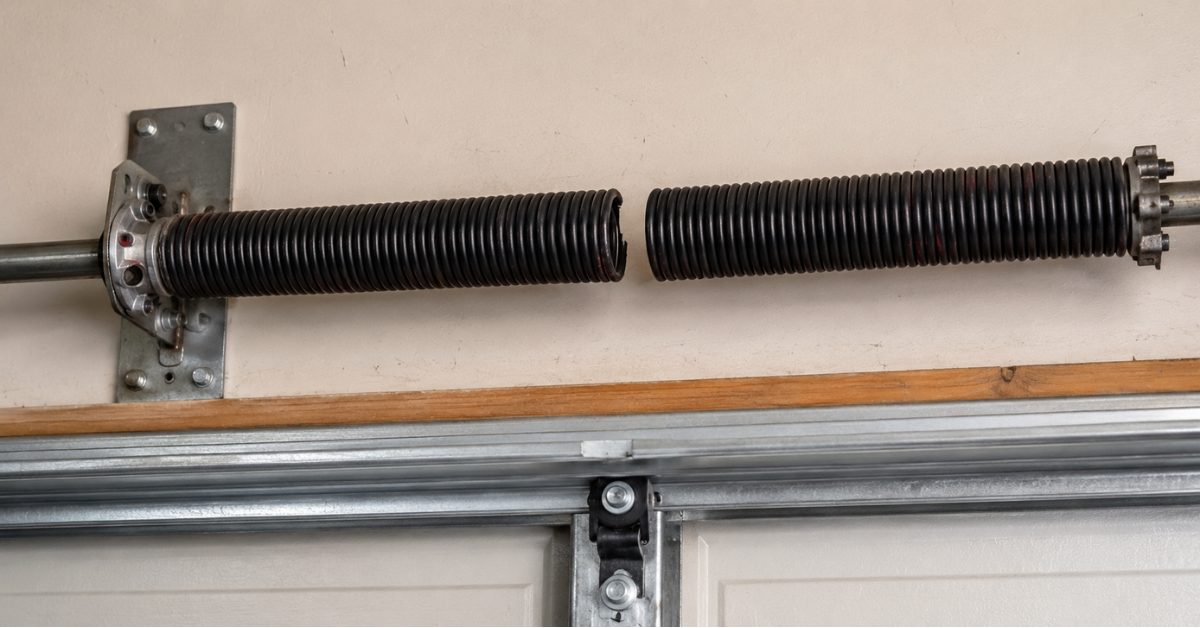
Most Colorado Springs doors use one of two systems. Torsion springs sit on a shaft above the door and lift by twisting; a broken one often shows a visible gap in the coils. Extension springs run along the horizontal tracks on each side and lift by stretching. If you are not sure which system your door has, the guide to torsion vs extension springs shows how to tell them apart from the garage floor. Either way, when a spring lets go, its weight lands on everything else.
Nothing about the door itself changed overnight. What vanished is the partner that was doing nearly all of the work.
How can I tell the spring is actually broken?
A broken spring usually announces itself clearly. Work through this list against what your own door is doing:
- A loud bang from the garage, like a board dropped flat — the sound of the spring letting go, sometimes when the door was not even moving
- The door opens a few inches, then stops, as if the opener has given up partway through the lift
- The opener runs but the door barely moves, humming or straining while the door stays where it is
- One side lifts before the other, so the door rises crooked or sits tilted in its opening
- A visible gap in the spring coils above the door, where the coil has separated — the clearest sign of all on a torsion system
- Cables that look loose, slack or hanging instead of sitting tight on their drums
- The door feels far heavier than usual when you try to lift it by hand from fully closed
If several match, compare them with the full guide to broken garage door spring symptoms. One caution: if you are not sure the spring is broken, treat it as broken. Do not keep testing the door with the remote to find out — every forced attempt can add damage on top of the break.
What happens if I use the opener anyway?
It is tempting to think the opener can simply work harder for one morning. It cannot — it was built to guide a balanced door, not to deadlift an unbalanced one. The motor strains against weight it was never sized to lift, and the parts that pay first are inside the drive: gears can strip, drive components wear or fail, and a motor forced through repeated straining cycles can burn out.
The damage does not stop at the opener. Under an uneven load, lift cables can slip off their drums or snap. The door itself can jam in its tracks as one side is dragged ahead of the other, or drop instead of settling.
Pay attention to what the opener is telling you. Openers have force settings and a safety reversal for a reason — a door that keeps stopping or reversing is not being stubborn; it is sensing resistance it cannot safely overcome. Pressing the remote again and again does not fix the spring — it turns a spring problem into a spring-plus-opener problem. While the door is in this state, keep children and pets away from it entirely.
Is a single-car door different from a double-car door?
Yes, and the difference matters. A single-car door with a broken spring is heavy enough to be genuinely dangerous — well over a hundred pounds of dead weight with nothing holding it up. Even so, two adults can sometimes manage a slow, controlled emergency lift on a single door, using the method below.
A double door is a different proposition: wider, heavier, often insulated, and far harder to keep level while two people lift. If one side rises faster than the other, the door can bind in its tracks, twist, or jam partway up — the worst position of all. The rule for a double door is therefore stricter: unless it moves easily and stays level with two people lifting together, leave it closed. And whatever the door size, never try to lift it alone.
What if only one of two springs breaks?
Many doors run on two torsion springs sharing one shaft, and it is natural to assume the other can cope if one breaks. It cannot — not safely. The surviving spring still carries part of the load, which can make the door feel almost normal for the first few inches of travel. That near-normal feeling is the misleading part.
The remaining spring is now carrying an unbalanced load it was never meant to hold alone, and the door will usually hang or travel crooked as a result. The survivor has also done the same work for the same years as the spring that just failed — it is at the same point in its life. Do not treat a half-working door as a safe door, and do not rely on the remaining spring to hold the door open while anyone passes underneath. The advice is unchanged: leave it closed if you possibly can.
My car is trapped — what is the safest emergency way out?
Read this first: this is an emergency-only method, not a routine way to use the door. It applies only when a vehicle is trapped and there is no other way out. If anything about the lift feels wrong, stop — that feeling is the answer.
1. Clear the area. No one stands under the door or in its path, and children and pets stay out of the garage completely.
2. Disconnect the opener only with the door fully closed, by pulling the red emergency release cord. Never pull it while the door is open — an unbalanced door can fall.
3. Lift with two adults, one on each side. Raise the door slowly, keep it level, and talk as you lift so both sides travel together.
4. Stop the moment it resists. If it will not move, feels uneven, or either person cannot hold their share, stop at once, lower it gently, and leave it closed.
5. If it opens, move promptly and stay clear. Do not leave it standing open or work under it, and let no one stand in its path. Move the vehicle out, then lower the door fully and slowly, again with two people.
6. Leave it closed afterwards. Once the vehicle is out, the door stays shut and unused until the spring is repaired.
A word about clamps, honestly: a clamp on the track can help a raised door resist sliding down while a vehicle is moved. But a clamp is not a repair, and no reason to leave the door open, prop it with a ladder, or go underneath it.
Why is this worse on a cold Colorado Springs morning?
Cold mornings on the Front Range are when many springs fail, for reasons that stack up. Steel is less forgiving in a hard freeze, and a spring worn by years of daily cycles is most likely to snap on the first cold lift of the day — often overnight, so the failure is discovered at the worst moment, with the car needed and the door dead.
Cold adds a second trap. Overnight frost and meltwater can refreeze along the bottom seal, so the door can be stuck to the floor at the same time it has lost its spring support — and pulling harder answers the wrong one. Many Colorado Springs households use the garage as the main entrance, so a stuck door at rush hour feels like an emergency — but rushing the lift is exactly when injuries happen.
The local housing mix shapes the risk. Newer subdivisions around Briargate and along the Powers corridor are full of wide, insulated double doors — the heaviest kind to face without a spring. Older homes in Old Colorado City often carry heavier panel doors on older hardware. Out in Black Forest, a garage may sit well away from the house, so a problem goes unnoticed until the morning it fails. Hail season leaves a legacy, too: dented panels or tracks knocked out of true make an unbalanced door bind more readily. It is why a door that worked fine yesterday can fail overnight here.
What should I never do with a broken spring?
Some mistakes turn a broken spring into an injury or a much larger repair. Each of these is on the list for a specific reason:
- Never try to wind, adjust or replace a spring yourself. Torsion springs store a large amount of energy, and the winding bars and technique they demand are not a homeowner job — a slipping bar can release it instantly
- Never stand under a raised, unbalanced door. Nothing holds it but friction and luck, and it can fall without warning
- Never prop the door open with a ladder, a chair or a board and walk away. A prop is not a support — a knock or a gust can bring the door down
- Never keep pressing the remote to force it. Each attempt strains the opener, the cables and the door — the spring is not going to change its mind
- Never pull the release cord while the door is open. Disconnecting an open, unbalanced door removes the last thing slowing its fall
- Never let children operate the door or play near it while the spring is broken — a door in this state does not behave predictably
- Never drive under a door that is only partway open. It can drop or snag on a roof rack, a mirror or an antenna
None of these rules is cautious decoration. Each one exists because the failure it prevents has a name: a falling door.
What do I do while I wait for the repair?
The waiting period is mostly about leaving things alone. Leave the door closed: it is the safest position the door can be in, and it keeps the garage secure. Use another entrance — a front door, a side door, or a pedestrian door into the garage that does not pass under the broken door.
While you wait, write down what you observed: the bang and when you heard it, the gap in the coils if you saw one, whether one side lifts before the other, and whether the opener runs at all. Those notes help the technician diagnose the problem faster and arrive with the right spring for your door’s weight. Clear the area in front of the door, and keep the opener remote out of children’s reach so the door is not cycled out of curiosity. Do not park another vehicle tight against the door or stack items against it.
One harder case: if the door is stuck partway open and you cannot lower it safely with two people, do not force it down. Keep everyone clear and arrange help promptly — a partway door should not simply be left and forgotten.
Safe DIY vs never DIY — the honest line
The line is plain, and worth stating in one place. Safe homeowner steps: looking for a visible gap in the spring from a few feet back; listening for the symptoms above; keeping the area around the door clear; noting down what the door does; and disconnecting the opener with the door fully closed. These are observation and housekeeping — nothing is loosened, wound or adjusted.
Never DIY: anything that involves spring tension. Winding, unwinding, replacing or adjusting a spring is never a homeowner job, and neither are the cables, drums and bottom brackets connected to that tension. Add one more: holding a heavy door open by hand while someone else drives out from underneath it. The cost of getting spring work wrong is not a scratched panel or a wasted morning. It is a falling door, and that is the whole argument for leaving tension to a trained technician. When you are ready, garage door spring repair is the service that covers it.
“But I need to get to work” — handling the real objection
All of the above is easy to write and harder to live at 7 a.m. with a shift starting, a school run due or an appointment across town. The pressure is real, and it deserves a straight answer rather than a shrug. Before the emergency lift, run the alternatives honestly: another exit, another vehicle outside the garage? Can a neighbour, a family member or a ride service cover this one trip? Can the start be rescheduled, the appointment moved, the day’s plans rearranged around a door that stays shut?
The emergency method in this guide exists for the cases where the answer to all of that is genuinely no — and its stop conditions are not optional garnish. A door that will not move easily is telling you something about its weight, its balance or its tracks, and listening to it beats dealing with a fallen door or a damaged opener. For everything beyond this one repair, the Colorado Springs garage door repair homepage is where the wider service starts. A missed morning is a bad day. Forcing the door can make it a much worse one.
What should you do next if your spring has broken?
If your spring has broken, leave the door closed and arrange garage door spring repair rather than forcing the door — a closed door is secure and safe to leave while you plan the visit. The next article in this series explains what happens during a spring replacement visit: what gets measured, matched and tested before the door is handed back to you.
Questions homeowners ask about this topic
Can I open my garage door with a broken spring?
Short answer: avoid it. The door carries its full weight, will not stay up on its own, and can fall without warning. Leave it closed unless a vehicle is trapped and you can use the two-person emergency method safely.
Will my opener lift a door with a broken spring?
No, it should not be used for that. Openers are built to move a balanced door. Forcing one can strip gears, damage the drive, or snap a cable, and the door may still not open.
Does pulling the red emergency release cord fix the problem?
No. The cord only disconnects the door from the opener. It does not change spring tension, and pulling it while the door is open can let an unbalanced door fall.
Can I leave the door propped open until the repair?
No. A propped door is not a secured door. It can slip, fall, or be pushed, and it leaves the garage open. Lower it fully and leave it closed.
Can I drive under a door that is only partway open?
No. A partway door with a broken spring can drop or catch on the vehicle. Do not drive under it; get the vehicle out only with the door fully and safely raised by two people, or leave it where it is.
Stop before tensioned hardware
Do not unwind torsion or extension springs, loosen cable drums or bottom brackets, bypass photo eyes or push an off-track door into place. If the door becomes heavy, crooked or unsupported, keep people clear and use the emergency garage door repair guide.
Which garage door service pages should you read next?
Which related Colorado Springs guides add context?
Not sure what failed?
Describe what the door is doing, its current position and any visible damage. Same-day slots can fill fast, but timing is only confirmed after contact. Calls are answered 24/7 at (719) 403-0616.